

My cousin tells a story: Several years before I was born, she was sitting on our great-grandmother’s lap at her modest home in a hollow in Eastern Kentucky. It was the late 1970s, when Dolly Rebecca Parton was well on her way to conquering the worlds of pop, Hollywood and business. They were watching a rerun of “The Porter Wagoner Show,” the program that had helped launch Dolly to country music stardom, on a little TV set using rabbit ears, when she appeared. Even though our granny was, like all people in the mountains, well acquainted with Dolly by that point, she was still transfixed. Using the descriptive phrasing that was common then among older people, she said, “That is the prettiest little girl I have ever seen.”
It was a simple, truthful observation from a woman who herself knew the bleaker side of life, birthing and raising 11 children in a time when money was scarce and hard work provided barely enough to scrape by. But as news of Dolly’s death at the age of 80 from cancer sinks in, I keep returning to it, thinking about its meaning. The singer-songwriter from Locust Ridge, Tennessee, whose songs became an indelible part of American life and who performed all over the world in places grand and humble, was beautiful in every sense of that overused word, and based on the accolades she is now receiving, only the most bitter of contrarians would disagree.
(Michael Ochs Archives/Getty Images) Dolly Parton and Porter Wagoner on the set of “The Porter Wagoner Show,” circa 1967.
My cousin’s story is important to share because of what it reveals not only about Dolly, but also about her people and her native region. Far too often, and for far too long, Appalachia and its residents have not been seen as beautiful to the much of the country. The journalist Annie Lowrey summed it up in her bracingly titled essay “What’s the Matter with Eastern Kentucky?”, which appeared in the New York Times Magazine in 2014. The region, she wrote, was the “smudge of the country,” an unfortunate phrase that was at once dismissive of the place and evoked a set of damaging stereotypes that have long been leveled at Appalachians themselves: unclean, dirty, something to be wiped away and forgotten. Because of a long history of such characterizations and perceptions, mountain people have often been forced to locate the beauty within themselves and their culture.
It’s easy to forget now, but there was a time when the woman who wrote masterpieces like “Jolene,” “Coat of Many Colors” and “I Will Always Love You” — and deeper cuts like “Down From Dover,” “My Blue Tears” and “Wildflowers” — was reduced or dismissed altogether by the very American culture that now embraces her. A “Backwoods Barbie,” as she would later write: too gaudy, too blonde; all breasts, no substance. Common, sexist ways to dismiss women who dare to be themselves.
But Dolly was also written off in some quarters because of her place of origin and how she spoke. Still, she never shied away from claiming her mountain identity; she never tried to change herself. Unlike her famous wigs, rhinestones and stilettos, it wasn’t something she could, or would, remove. Instead, like so many Appalachians before and since, she learned to leverage it to its best advantage, taking patronizing moments — like one that came in a 1978 interview with Barbara Walters, when the journalist infamously asked her, “Dolly, where I come from, would I have called you a hillbilly?” — and turning them in her favor. “If you would have,” Dolly replied, “it would have been something very natural, but I would have probably kicked you in the shins or something.” Then she pivoted to speaking about her pride at being from East Tennessee.
As much as she was proud of where she was from, Dolly also spent the latter part of her years preaching and living out loud a sermon to her native region. Grounded in love, her message also came with an implicit challenge: You can do better.
As much as she was proud of where she was from, Dolly also spent the latter part of her years preaching and living out loud a sermon to her native region. Grounded in love, her message also came with an implicit challenge: You can do better.
As a place, Appalachia is just as good as any other, but it is also just as flawed. In many ways, the region is itself a microcosm of America as a whole, and just like in other parts of the country, it has become dominated by a reactionary set of beliefs that are the antithesis of who Dolly was and the radical gospel of inclusion she embodied. This made her representation of Appalachia even more critical, particularly after the 2016 presidential election that saw the majority of the region rejecting those values. In many ways, Dolly was the counterpoint of JD Vance, whose claiming of mountain roots provided the basis for his first memoir, “Hillbilly Elegy” — a book filled with regional stereotypes — and for his political identity. (As of this writing, the vice president has made no public comment about her death, an omission that makes its own statement about his Appalachian bona fides, not to mention his political instincts.)
Although Dolly famously refused to be overtly political, her values were clear. In shouts and whispers alike, she made sure people felt valued. In 1989, at the height of the AIDS epidemic, she served as a producer of “Common Threads: Stories from the Quilt,” the Academy Award-winning documentary that profiled people who had died from the virus and were featured on the AIDS Memorial Quilt. Five years later, she championed the LGBTQ community in her memoir, and posed on the cover of Out magazine in 1997. The writer Elissa Altman, who edited Dolly’s memoir during her time as an editor at HarperCollins, recalled yesterday in an Instagram post that the singer paid for the gender-affirming medical care of “a member of her team [who] was transitioning . . . in the 90s.”
Dolly’s messages of affirmation and acceptance were pivotal for scores of queer Appalachians and Southerners. For so many of us, she was the first safe space that we knew in our own culture. And when her embrace rankled the fundamentalists among us, she didn’t back down, often calling them out in their vain attempts at playing God.
In a 2020 interview with Billboard, given at the height of the pandemic and protests for racial justice, Dolly made clear where her heart was. “I understand people having to make themselves known and felt and seen,” she said. “And of course Black lives matter. Do we think our little white a**es are the only ones that matter? No!” Dolly also put her money behind her message. After Whitney Houston scored a massive hit with “I Will Always Love You” in the early 1990s, she invested some of her royalties from the song in a Black neighborhood in Nashville, Tennessee.
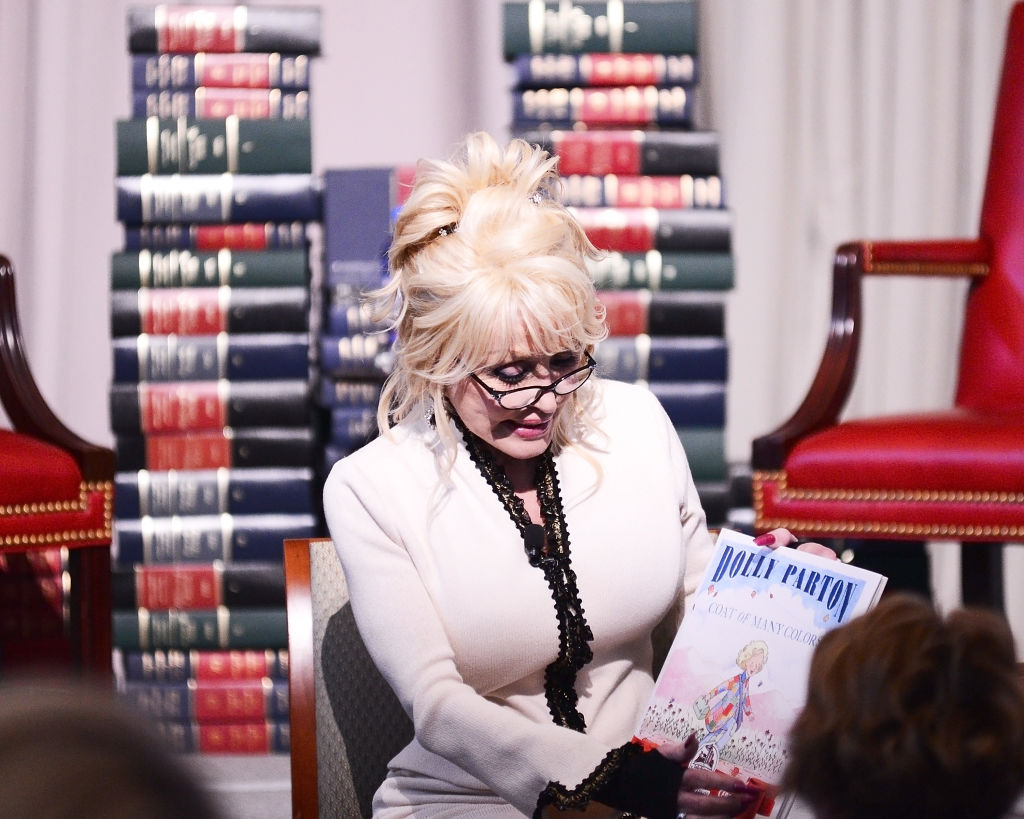
(Shannon Finney/Getty Images) Dolly Parton reads from her book “Coat of Many Colors” to schoolchildren at the Library of Congress on Feb. 27, 2018.
Then there is her Imagination Library, which has reportedly distributed over 300 million books to children around the world since its launch in the late 1980s — an effort Dolly counted as her proudest achievement. It, too, came from the heart of Appalachia, founded to honor her father, who had a story common in the mountains during those times. Raised in poverty and forced to leave school to help support his family, Robert Lee Parton was unable to read. His daughter, though, was a voracious reader, becoming a champion of Appalachian authors like Adriana Trigiani, Lee Smith and my husband Silas House, and seeing literacy and education as its own kind of salvation. Here, too, Dolly offered her region a tacit challenge by promoting the education reading can provide and, just as importantly, the empathy it can unlock. As much as she would have likely denied it, putting books in kids’ hands, particularly during a time of increasing book bans, was its own kind of a political act.
Dolly’s final public appearance came in June when, true to her entrepreneurial form, she appeared at the opening of Dolly’s Tennessean Travel Stop, a Southern-friend truck stop designed to compete with the popular chain Buc-ee’s. Looking at video footage now, there were subtle warning signs of what was to come. While appearing to be her effervescent self, she was also more supported physically than usual, assisted to the podium. When she took up the oversized, bedazzled pair of scissors to cut the ribbon, two sturdy men made sure they had a firm hold on her. But she walked offstage to a new jingle that went, “At my Tennessean Truck Stop, everyone belongs.”
While the way much of the region votes may negate this message, there exists a massive minority in Appalachia that has always felt this way — and continues to practice it.
Appalachians can be a possessive lot, jealous over what and who we consider our own. Dolly was one of us, ours, but of course she was also much more. As much as she belonged to Appalachia, she also belonged to the world. It can’t be an exaggeration to say that tens of millions are grieving her death. Last night, news of her passing was the top story at Germany’s Der Spiegel, and it was among the main headlines on the websites of France’s Le Monde, Nigeria’s Punch News, India’s The Hindu and Japan’s Yomiuri Shimbun.
Her passing was also felt in the Middle East, where the president’s aimless war against Iran continues. A defense industry source told me that the “shock and grief” of Dolly’s death was so profound that it lit up military communications channels. Service members deployed in the region asked for confirmation that the news was true, and when told it was, they were broken up. Some said it felt as if the light had gone out in the world, just when we needed it most.
That light is what my great-grandmother recognized in Dolly all those years ago. She was Our Lady of the Mountains. Long may she shine — for the best parts of Appalachia, and the best in all of us.
Read more
by Jason Kyle Howard


