

Take it from someone who knows — it’s the odd ones out in the family who have the best chance of winning at life. Unburdened by the gravitational pull of parental expectations or affection, the alleged weirdo is free to find her way to happiness by whatever means she sees fit.
There’s an entire wing of fiction built around such iconoclasts, but “The Other Bennet Sister” and its reimagining of Mary Bennet (Ella Bruccoleri, “Call the Midwife”) may be the most attuned to our times. Mary is a bookworm who draws her apt conclusions about human behavior from written wisdom. All she needs is a cat, and she would be the scourge of conservatives everywhere.
But it is because of this that so many close readers of Jane Austen’s “Pride and Prejudice” have found a role model in Mary, a girl who in modern times would skip school dances for the more reliable company of a book or a movie. As for taking up any tradwife aspirations, forget it. Mary Bennet cares very little about finding a husband because all she’s ever heard is that she isn’t pretty or witty enough.
(BBC/Bad Wolf/James Pardon) Ella Bruccoleri as Mary Bennet in “The Other Bennet Sister.” Credit: BBC/Bad Wolf/James Pardon
Regardless of someone’s estimation that she is the most accomplished girl in the neighborhood, impressing the cream of Hertfordshire society is impossible for a girl like her. Once Mary starts wearing spectacles, her histrionic mother, Mrs. Bennet (Ruth Jones), gives up on her almost entirely. Her father, Mr. Bennet (Richard E. Grant), only wants his daughter to be able to see. But when he suddenly dies and the family’s estate, Longbourn, passes to another male relative, Mary resigns herself to a life sentence beside a mother who can barely stand her. That is, until an affectionate aunt and uncle, the Gardiners, intervene on Mary’s behalf, inviting her to London and a fresh start.
I’ve always held a soft spot for the Forgotten Child types in fiction, which is easy enough since they’re usually the ones who are interesting enough to feature in TV series and movies. But Mary is different from the superpowered variety of the trope, or the brilliant outcasts in teen movies like “Mean Girls,” “Sixteen Candles,” “The Edge of Seventeen” or “The Perks of Being a Wallflower.”
All these heroes and heroines are recognizably cool to their audiences, while the kindest thing Austen can say about Mary is that she’s the plain middle sister sandwiched between two hotties on the older side, Jane and Elizabeth, and two rambunctious younger ones, Kitty and Lydia.
The world’s Marys understand that while beauty fades, the art of fascination has no expiration date.
If every author is a parent to their characters, then Austen, Mary’s true mother, is a good deal crueler than Mrs. Bennet. She describes her as having “neither genius nor taste; and though vanity had given her application, it had given her likewise a pedantic air and conceited manner, which would have injured a higher degree of excellence than she had reached.”
In “The Other Bennet Sister,” Janice Hadlow, who wrote the 2020 novel on which the 10-episode series is based, plays the loving benefactor with a reading that’s far more generous and understanding. In her view, Mary is an introvert who simply needs people like her aunt (Indira Varma) and uncle (Richard Coyle) to encourage her to redefine the terms of her life. Among new friends in London, Mary’s studiousness makes her a formidable intellect. That she is entirely unlike most other women conforming to common definitions of femininity and “proper” etiquette captures the attention of two eligible bachelors: William Ryder (Laurie Davidson) is adventurous, charming and admires Mary’s willingness to buck social convention. Tom Hayward (Dónal Finn), meanwhile, is a kind man who loves poetry and, yes, also wears spectacles.
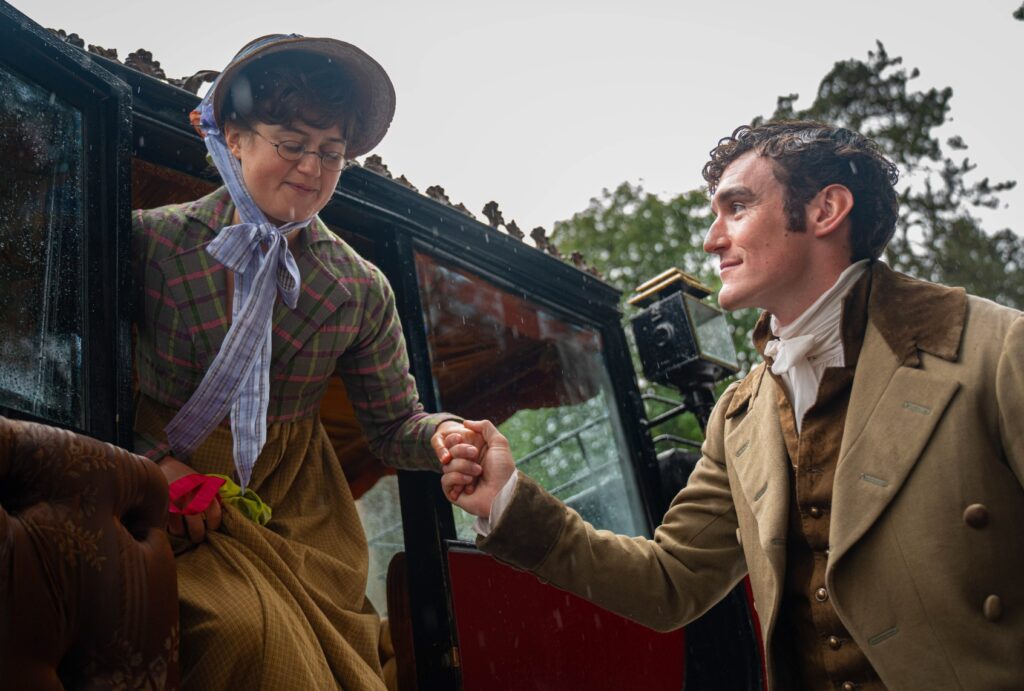
(BBC/Bad Wolf/James Pardon ) Ella Bruccoleri as Mary Bennet and Donal Finn as Mr. Hayward in “The Other Bennet Sister. Credit: BBC/Bad Wolf/James Pardon
In Austen’s eyes, it’s Lizzy, not Mary, who is the black sheep. Mrs. Bennet may not care much for her little bookworm of a girl, but “Pride and Prejudice” specifies Elizabeth as her least favorite child; Mary is simply easier to ignore.
Even so, Austen fulfills the reader’s assumption that her strong-willed heroine is attractive enough to find a love match – and not just any old chap but one of the greatest romantic leads in all literature, Mr. Darcy.
Mary, on the other hand, is a clumsy bird who, in Hadlow’s telling, becomes a perfectly capable duckling swimming fiercely amid a bevy of swans. No wonder audiences made “The Other Bennet Sister” a hit in the U.K., where it premiered to 7.3 million viewers across all BBC platforms.
Ours is an age not only of cultural backsliding but also of people uprooting themselves for the sake of safety and reinvention. Today’s Marys have left or are leaving behind the places where they never fit in, whether that’s school, church, their families or group chats or social media feeds, to find places that welcome them as they are. She would be the person opting out of demands to dress, look and behave a certain way to appease the opposite sex. In life, she’s the kid who realizes that parents don’t love all their children equally, and instead of lamenting that absence, surrounds herself with a chosen family that values her as she is. The world’s Marys understand that while beauty fades, the art of fascination has no expiration date.
Want more from culture than just the latest trend? The Swell highlights art made to last.Sign up here
This year brings us at least three significant Austen adaptations. Aside from “The Other Bennet Sister,” Daisy Edgar-Jones will topline a new version of “Sense and Sensibility” set to debut in the fall. Sometime in the second half of the year, Netflix is rolling out a six-part miniseries version of “Pride and Prejudice” starring Emma Corrin as Lizzy Bennet and introducing Hopey Parish as Mary.
“The Other Bennet Sister” represents Bruccoleri’s first major role where she’s leading the action instead of hugging a wall, unvarnished by cosmetics or anachronistic needle drops hinting at some hidden reserve of chic. This is not a tale where the heroine’s acceptable aesthetics are revealed by her removing her glasses or allowing her tousled waves to tumble out of a tightly pinned hairdo. No, Mary is who she is, glasses and all, and it’s our pleasure to truly see her with the 20/20 clarity she deserves.
“The Other Bennet Sister” is streaming on BritBox.
Read more
from Salon’s Culture newsletter, The Swell


