

Despite ostensibly being about a world-famous pop star mounting a major comeback, David Lowery’s latest film, “Mother Mary,” rarely leaves the confines of the drafty farmhouse it’s set in. There, on a stead in rural England, equally prolific couturier Sam Anselm (Michaela Coel) toils away producing her latest collection, with seamstresses and assistants dotting the corridors of her sprawling property. The locale is haunting, but not haunted, at least not until the titular diva Mother Mary (Anne Hathaway) crashes through its doors in frantic search of both Sam and some respite, gliding through the estate like a rain-soaked ghost with unfinished business.
With the raw certainty of a medium reaching into the future — or perhaps more accurately, someone feeling a fever coming on — Sam has been anticipating Mary’s arrival. “You’re like a carcinogen,” Coel narrates, her low, full voice filling up the room. Mary’s presence is a malignancy, a blight on the name that Sam has worked so hard to build, an identity that’s separate from Mary’s and secure in its solitude. But although it’s worn and weathered, the tie that binds these two is indestructible. Sam and Mary give and take in equal measure, wrapped in a continuum made from red silk. So when Mary, soaked to the bone and tail between her legs, comes asking for the perfect dress, Sam can only scoff. Even after all their years apart, it’s still business as usual.
(Eric Zachanowich/A24) Anne Hathaway and Michaela Coel in “Mother Mary”
Lowery explores the wounds inflicted by fame’s piercing orbit, implying that absolution isn’t attained by climbing stardom’s echelons, but by falling just before reaching the top, hitting every last regret on the way down.
Lowery’s frenetic opening sequence deftly builds the film’s phantasmic framework. Everything in “Mother Mary” feels like it exists in a dream within a dream: the tertiary characters who fade in and out of the narrative, the catchy yet indistinct pop songs, the dreary midnight-blue location. Watching the film is akin to trying to explain a night’s reverie to a friend, with specific details just out of reach and fading the faster you try to remember them. “I was there, and I was a pop star — my thing was wearing ornate halos all the time,” you might say. “You were a designer and we really hated each other. I can’t remember why. There was this big concert with an arena full of people, but it also felt empty. Backstage, I met FKA Twigs and she came back to my house to hold a seance. Kaia Gerber was there, I think? Mostly, I remember how mad we were, and how neither of us could find the right words to express why.”
All of this ambiguity is intentional, sewn into the script with as much care as Sam stitches her dresses. Unlike recent explorations of pop superstardom in “The Moment,” “Smile 2” or “A Star is Born” — all fascinating depictions that focus on the varied perils of fame — Lowery aims for something more enigmatic. His film has less to do with celebrity itself than with the humanity that exists somewhere beneath all the crowns and gowns, and what happens when that autonomy is reduced to a flicker, buried under mountains of sorrow too formidable to parse on our own. The only chance of clearing the rubble and preserving the light is to ask for help, and to trust that the person offering it won’t betray you, even if they have every reason to do so.
Lowery makes proficient use of the confined setting where Sam and Mary reunite, building a two-hander chamber drama around Coel and Hathaway’s fervent commitment to the weird and inane. “Mother Mary” is as hair-raising as it is eyebrow-raising, all spectral senselessness until, out of nowhere, the eeriness gives way to a startling profundity as the film explores remorse with biblical repercussions. Here, lament cannot be hidden, only exorcised. Lowery has little interest in pitying Mother Mary or making her the unwitting victim of the pop star industrial complex. Instead, he explores the wounds inflicted by fame’s piercing orbit, implying that absolution isn’t attained by climbing stardom’s echelons, but by falling just before reaching the top, hitting every last regret on the way down.
Mother Mary, then, has just reached her rock bottom, with Sam’s good graces barely cushioning her fall. The two women reconvene after years estranged, pulled back together by a cosmic force that neither of them quite understands. Mary is disoriented and desperate, and the mere sight of her assures Sam that whatever favor Mary asks for, Sam can attach strings to.
Want more from culture than just the latest trend? The Swell highlights art made to last.
Sign up here
Mary needs a dress. But not just any dress; one that only Sam can construct. Not because she’s the most respected designer in the U.K., or because it was convenient for Mary to ditch her posse of managers and assistants to hop a flight to Sam’s studio, but because Sam is the only person capable of seeing the things Mary can’t bear to look at herself. Sam reluctantly agrees, but insists that she needs more information. After all, Mary’s details are vague and muddled. She’s a pop star caught outside of time, unable to give a straight answer about why this next show is going to be so important. She only wants to play the music. Please, can’t she just play the music? The new song — “the best song ever written in the history of songs” — is so good, she claims. Hearing it will help the dress come to life.
But Sam has no interest in the music. What she wants is an apology, and Mary batting her eyes and offering her heartfelt pardons won’t be enough. “Catch me by surprise with your sincerity,” Sam tells her old friend, planting the seed for all that follows. In the meantime, they’ll talk.
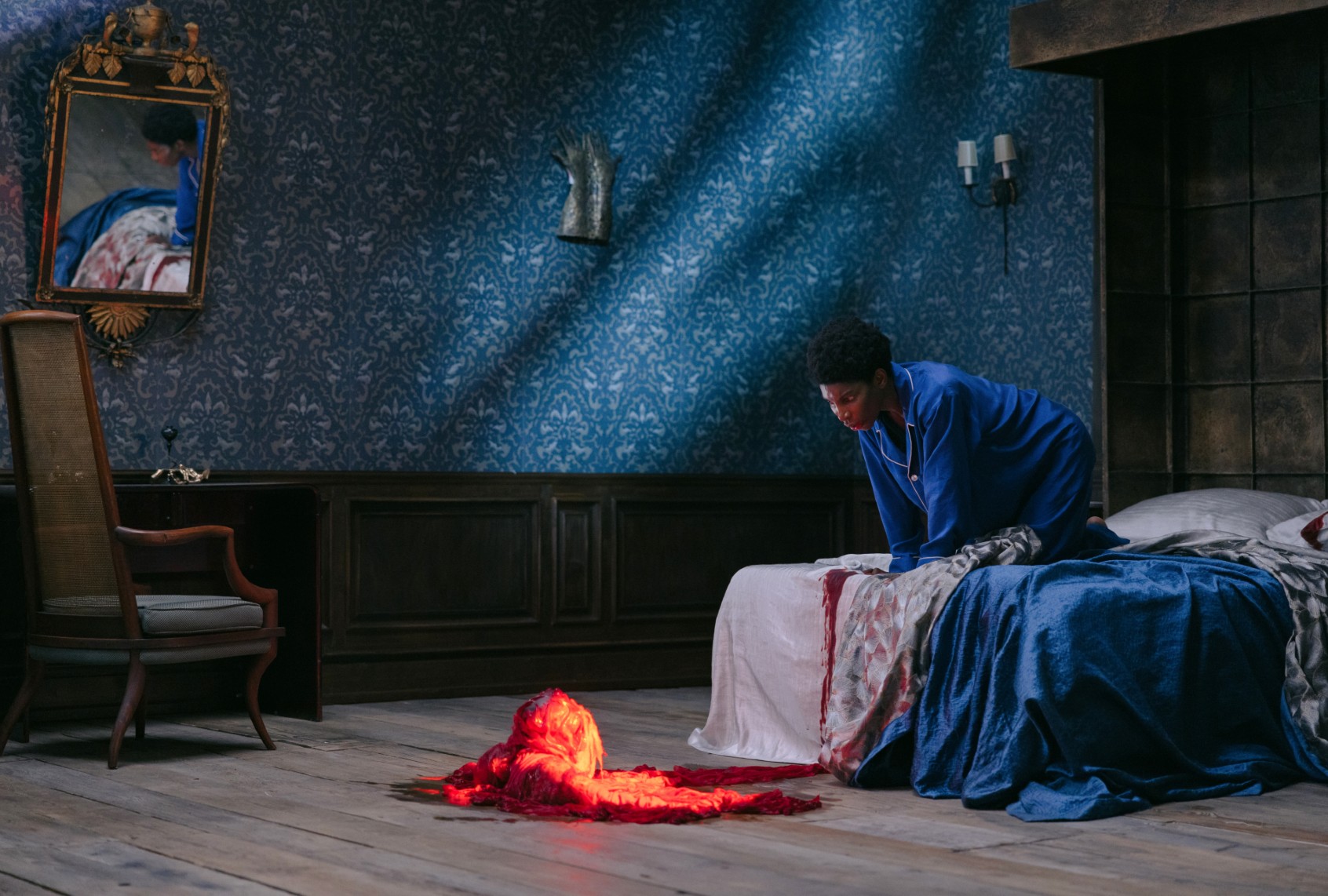
(Eric Zachanowich/A24) Michaela Coel in “Mother Mary”
Anyone showing up for a film replete with big-budget pop spectacle will be thrown for a loop by Lowery’s dialogue-heavy screenplay. There are still a handful of musical numbers. (Those Charli xcx, Jack Antonoff and FKA Twigs writing credits weren’t free!). But Mother Mary’s performances are dextrously woven into a script that more closely resembles a stage play than a concert. That does not, however, mean that “Mother Mary” isn’t about pop music. In fact, it’s got more pop DNA than many of its contemporaries — just don’t expect the intricacies to come from Mother Mary’s music or her mythology.
Time gets in the way. People move on to other things, make new friends and find other lovers. But the phantoms of the past remain, haunting our dreams and taunting us with the comfort of imagined reconciliation, until we wake up and it slips away. To be unmoored by the shadows of our past is a gift no fame or fortune can afford.
Together, Lowery and Hathaway Frankensteined their fictional goddess from pieces of just about every major pop star. Mother Mary’s signature headpieces are a Beyoncé trademark. Her concerts are sparse and Swiftian. Her hand tattoos resemble Ariana Grande’s. And she once showed up to an event covered in nothing but freshly poured honey, a nod to Lady Gaga’s meat dress. But all of that says little about this film’s take on the pop machine, other than that Lowery did his homework to perfect an aesthetic. “Mother Mary” doesn’t truly come alive unless one is willing to engage with its dense and frequently dour text, which opens with patience. Like a great pop song, the meaning is both immediate and richer with every subsequent listen, informed by all that occurs while time’s passing.
Like an ever-so-slight key change in the final chorus, “Mother Mary” gradually contorts the longer Sam and Mary talk. By the time the film reaches its centerpiece sequence — a throbbing, abstract depiction of the pursuit of fame as biblical betrayal, and pop superstardom as a Christlike crucifixion — it all gets a bit hokey, yet never more enthralling. The deeper Lowery digs into the barbed tension between his two lead characters, the more fascinating their story (and his film) becomes. For as melodramatic as the movie can be, its conflict is founded on something as simple as lingering pain; a grudge that has since grown softer and easier to live with, though no less agonizing. It helps, too, that, by the nature of the film’s long-winded narrative structure, we’re able to witness the pretenses between Mary and Sam slowly fall away. What’s left is a shared ghost, an apparition that connects the two women. And as they chat, they realize that they’ve been having the same dream.
We need your help to stay independent
If you’ve ever fallen out with a lover or a friend who meant something dear to you, something singular that no one else has ever quite been able to capture again, where Sam and Mother Mary’s journey ends will resonate deeply. Anyone who’s wished that they could have one last exchange, one final goodbye or apology, will find a bone-deep significance in the way Lowery reconnects his two leads. Their reunion is surreal because it’s predicated on their mutual ability to admit fault, something that few of us have the opportunity to do after we walk away from a loved one scorned. Time gets in the way. People move on to other things, make new friends and find other lovers. But the phantoms of the past remain, haunting our dreams and taunting us with the comfort of imagined reconciliation, until we wake up and it slips away. Only when these apologies come do the ghosts finish making their rounds. To be unmoored by the shadows of our past is a gift no fame or fortune can afford.
Unlike the other big-budget pop spectacles, “Mother Mary” succeeds by striving for little more than realism — a funny thing to say about a film so boldly bizarre (or, perhaps, bizarrely bold). But where its cinematic peers get snared by trying to elucidate the truth of the pop star, Lowery’s film skates past the conventions and trappings, landing on something high-concept but deceptively straightforward. “Mother Mary” is a tale of forgiveness and regret, of reconciliation and farewells, dressed up in ruby-red tulle and holding five Grammys, trying to see if its audience will follow a fictional pop star to the ends of the earth before cautioning their recklessness. It’s strange and unpredictable, but then again, any pop star should be. No one wants to know exactly what their favorite artist will do next. And by pivoting away from cinema’s recent penchant for celebrity commentary to face the stripped-down human truth, “Mother Mary” is a reinvention fit for a superstar.
Read more
about unique pop star stories
Natalie Portman is a force of nature in intense and stunning “Vox Lux”
To be a fan is to be a parasite
Prince on film: from humble MTV beginnings to camp masterpiece “Purple Rain”
The post The divine lessons of “Mother Mary” appeared first on Salon.com.


