

If you live in Los Angeles, San Francisco, Portland, Seattle or any city with a high population of Burning Man devotees, it’s nigh impossible for “The Man Will Burn” to be a prejudice-free viewing experience.
If you don’t, the extent of what you know about Burning Man is likely based on the breathless cable news coverage of 2023’s Mudpocalypse, or headlines like this: “Burning Man’s Orgy Dome asks for help.” I assure you that it did not originate in The Onion.
No counterculture event is more shrouded in hype than this annual gathering of thrill-seekers, Instagram influencers, billionaires and whichever artists can still afford to attend. People from some walks of life, ranging from the upper middle class to the .001%, shed their social divisions and come together in the Nevada desert to party and screw and inhale art and drugs and open all their chakra holes or whatever.
(Courtesy of HBO) Zoe
Then they bring that energy home with them. You will know these beings, called Burners, by their love of neon fake fur, white girl box braids and disconium stretch pants. They may also insist on being called by their Playa name, something like “Dirty Rizz,” even though their driver’s license identifies them as Derwin.
Hence my interest in Jehane Noujaim and Vikram Gandhi’s four-part docuseries. I was genuinely searching for real answers in “The Man Will Burn” to lingering questions like, what’s up with these clowns and why do so many people despise them? Noujaim and Gandhi don’t provide answers. Not intentionally, anyway. What we can surmise is purely based on who they feature over its four hours and who’s left out.
Like The Orgy Dome, for instance.
Three episodes of “The Man Will Burn” have aired with very little interrogation of how well it lives up to its hallowed 10 Principles, one of which is Radical Inclusion. In a docuseries about an overwhelmingly white community, a Black artist’s camp receives the briefest drive-by. Granted, one of the people the series follows, Ray Christian, is a Black veteran from North Carolina who finds community with a welcoming camp from his area.
Overall, though, Noujaim and Gandhi would rather build their drama around Burning Man Project CEO Marian Goodell, a nice lady struggling to keep this hipster hootenanny alive.
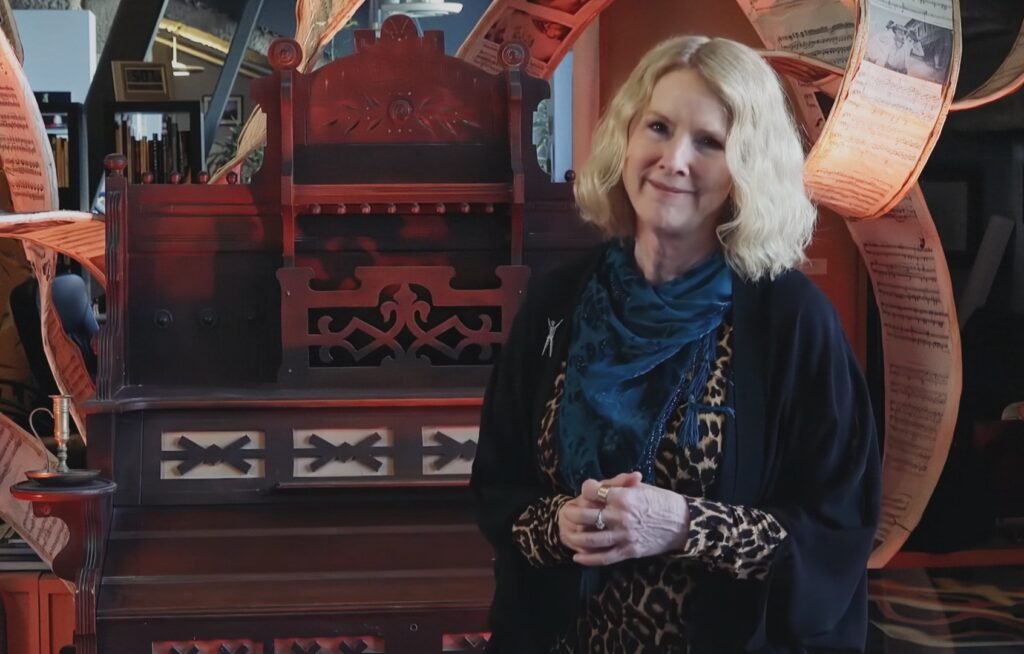
(Courtesy of HBO) Marian Goodell
Goodell and the senior members of The Org, as everyone calls the BMP, are the last connection to its late founder Larry Harvey, who died in 2018. Harvey’s dream began with a beach burn in San Francisco in the mid ‘80s. When the crowds grew too big, he and his fellow artists moved the festivities into the Nevada desert. Then, within the last few years, Elon Musk’s brother sailed into the chat on a raft of cash.
If “The Man Will Burn” has a villain, it is Kimbal Musk, the avatar for all the billionaires who changed Burning Man and the world for the worse after arriving on the scene a few years ago. It helps that he’s dressed as the Worst Guy at the Sex Jamboree, down to his cowboy hat – the modern safarist’s pith helmet.
Seattleites, however, can attest that Burning Man’s ruin began long ago, pretty much since Microsofties and Amazonians invaded it in the early aughts. Along with turning local party conversations into Olympic games for the obnoxious, these folks had the same gentrifying impact on The Playa as they did in historically non-white neighborhoods and overall affordability. The hagiographic tone of “The Man Will Burn” obscures that.
Burning Man turns 40 this year. If it were a person, that threshold might mark the start of some serious self-examination.
But it does make one wonder what Burning Man would be without tech bros. Indeed, where would all of us be?
“The Man Will Burn” has a similar value to Burning Man itself, in that you can either afford to care about its nonsense or continue living life like a person with bills to pay. Then again, for those of us who enjoy reading certain entertainment like tea leaves, even slight efforts like this provide a colorful gaze at how economic stratification upends systems originally meant to level the field for creative people, including ones meant purely for play.
It’s also obvious to any critical thinker that the idiot rich aren’t the only plagues on Black Rock City. Like any religion, to use the term Harvey drops in an audio clip, the problem isn’t the concept. It’s the people. A notion that blossomed from an idealistic vision was Martinized into a cult-like excursion for the privileged. Some make one week-long party into their whole identity. Those people are some of Burning Man’s worst PR reps, contorting the meaning of its principles to suit themselves.
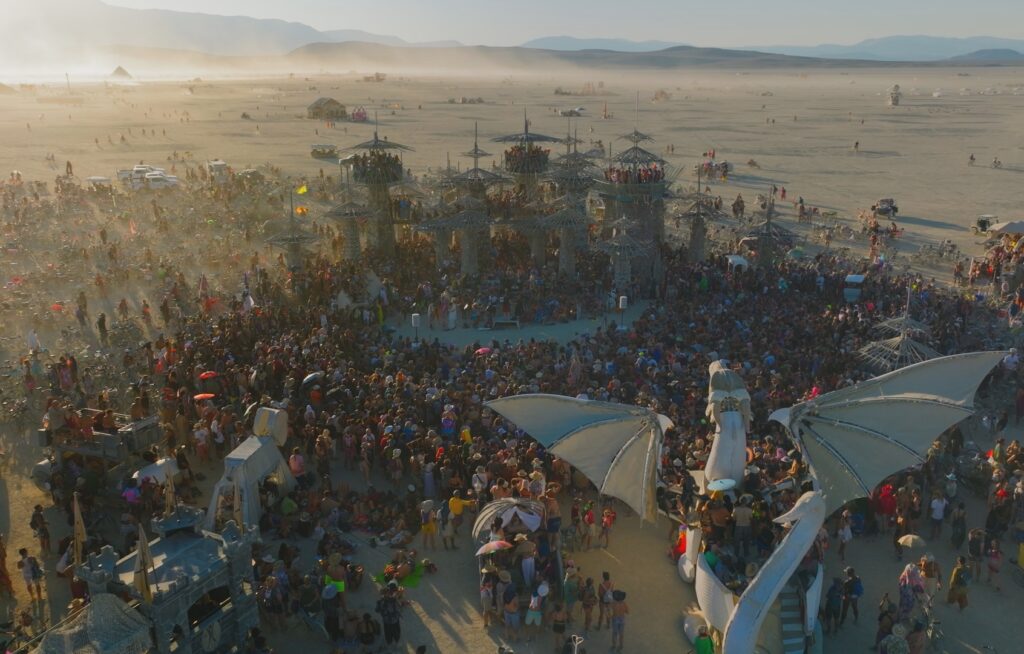
The episode witnessing the Renegade Burn, a bootstrapped Burning Man that took place while the COVID pandemic was still raging, exemplifies this. Those howling weekend barbarians hail their ability to pull it off as evidence of their Radical Self-Reliance and dedication to community.
Meanwhile, the locals in the nearby town of Gerlach, Nevada, worried about where all those people planned to defecate. In their bushes? Their yard? An enterprising shopkeeper stocks makeshift potties. That is the last we see or hear of that dirty business, which might as well be a visual metaphor for this docuseries’ shortcomings.
 ( Courtesy of HBO)
Much about the grimy parts of Burning Man is left unmentioned, leaving it up to Redditors to gripe about sanitation pile-ups departing Burners leave in nearby towns. If “The Man Will Burn” can’t be honest about where all the trash goes, we can’t be surprised at how little it goes into the underreported crimes linked to the event or its dire toll on seasonal laborers.
Burning Man turns 40 this year. If it were a person, that threshold might mark the start of some serious self-examination. Alternately, that’s a classic age to light the fuse on a midlife crisis by, say, divorcing, cashing out a 401K account and running off to Nevada in August to get blasted on psilocybin and ketamine while dancing nude in the middle of a dust storm. Who are we to judge?
Want more from culture than just the latest trend? The Swell highlights art made to last.Sign up here
For those very delights — oh, and the art too, yeah, sure — are why many people still want to go, a desire that watching “The Man Will Burn” will only strengthen. But you’re urged to also peek at the views beyond this pretty thing right in front of you, starting with the price tag. In 2026, tickets start at $550 per person plus $165 for a parking pass. That’s before calculating expenses for gear, food, water and other vital supplies.
No wonder the Orgy Dome’s keepers are fundraising. I’d rather not picture them doing that naked, but it’s fun to imagine some sparkly-faced busker on some corner in the Haight, singing an a cappella version of Sarah McLachlan’s “Angel” and passing the hat to pay for lube. But that can happen any place on any day, and nobody has to mess up an arid ecosystem to enjoy it.
“The Man Will Burn” streams new episodes over the course of four weeks, starting July 9 and ending July 30.
Read more
of our Burning Man coverage


