

As far as horror films go, writer-director Ian Tuason’s debut feature “Undertone” has just about everything a genre connoisseur could ever want, all rolled into one. The movie is packed with religious iconography, scary voices, possessed objects, ancient demons with silly names, maniacal senior citizens, dubious mirrors, dark corners, creepy children’s songs, creepy children’s songs played backwards, and — most terrifying of all — podcasters.
With the dust from the mid-2010s podcast boom finally settling, it was only a matter of time until the medium that has become an integral part of our daily lives got the star treatment. Podcasts have been supporting elements in horror for a minute, popping up in films like “Tusk” and 2018’s “Halloween” reboot, but they’ve yet to function as a true main character. Strange, considering the medium made true-crime and horror storytelling into a viable cottage industry. But whether you’re for or against that type of voyeuristic podcasting doesn’t matter here. Unlike other horror films, “Undertone” doesn’t make podcasters the butt of the joke or a predictable first-out kill. Tuason wisely skips all the gripes people have with podcasts and their hosts, and instead focuses on how the format can lend itself to horror. The covert appeal of shows like “Lore” and “My Favorite Murder” is their chilling sonic atmosphere. Horror podcasting isn’t just about the things that go bump in the night, but what those bumps sound like, and the images they conjure in a listener’s mind.
(A24) Nina Kiri in “Undertone”
In horror, more is more — more gore, more jump scares, more shadowed silhouettes; all in service of scaring the viewer. But it’s the less-is-more films that stay with us when the credits roll. And in floundering the ending, “Undertone” reminds us that tranquility can be far more unsettling than a cacophony of sight and sound.
In “Undertone,” all of the horror tropes are window dressing — elements to stimulate the eye while Tuason plays with the ear.
The movie’s real draw is its blissfully sinister sound design, which utilizes the podcaster lifestyle to go full maximalist while the film’s visual landscape remains sparse and disquieting. The discrepancy makes for a uniquely unnerving experience, especially in a theater with a decent sound system, where every unexpected thud can feel like it’s creeping in closer and closer.
But once the dread has reached a crescendo, “Undertone” makes a frustrating and near-fatal error in judgment, yanking the noise-canceling headphones off the viewers’ heads, pulling the rug out from under them and smashing every individually disturbing element together. For another horror film, one with less demonstrated interest in getting under the audience’s skin, this kitchen-sink climax could make for a memorable final act. But Tuason spends so much of the film compelling his audience to submit to the movie’s scant sights and sounds that his finale misses the mark, opting for classic genre frights in a movie that’s otherwise attempting something fresh. The stylistic bait-and-switch doesn’t just hamper the film’s momentum; it reveals just how silly the entire endeavor up until the climax has been. In horror, more is more — more gore, more jump scares, more shadowed silhouettes; all in service of scaring the viewer. But it’s the less-is-more films that stay with us when the credits roll. And in floundering the ending, “Undertone” reminds us that tranquility can be far more unsettling than a cacophony of sight and sound.
During a recent getaway to a remote cabin in upstate New York, I found myself thinking about why the quiet is so frightening. In the city, I rarely get freaked out at night. The low hum of cars passing and horns beeping in the distance gives me a sense of safety; I’m never alone. But upstate, miles from home and from any other soul, the reassuring statement became a question: What if I’m not alone? I locked the doors, calculated how quickly it would take me to run to the kitchen drawer with the knives if I heard a window break or a door handle rattle in the night, and fell asleep with no issue.
Want more from culture than just the latest trend? The Swell highlights art made to last.Sign up here
But it wasn’t always like that. As a child, I spent so many nights playing tricks on myself, twisting the shadows from trees outside my window into the most terrifying images my mind could dream up. I’d stare into twilight-tinged corners of my bedroom, convincing myself that I could see a human-like silhouette lurking in the dark, and spending what felt like hours thinking of all the things it could be. But every kid plays tricks of the imagination on themselves and eventually grows out of it. That’s why horror — particularly horror films that can evoke a primal, childlike sense of fear without exploiting conventionally scary imagery or sounds — is so compulsively watchable: It allows our imagination to run wild once more, but in a safe, contained manner.
Initially, “Undertone” is adept in producing a simple, familiar atmosphere, where fear can be easily manifested come nightfall. Evy (Nina Kiri) is staying at her ailing mother’s home, taking care of her while she creeps toward death in a vegetative state. Evy’s environment would be disconcerting enough as it is, but when she’s not quietly grappling with the inevitable passing of her mother, Evy’s hosting the Undertone podcast, where she and her cohost, Justin (Adam DiMarco), discuss and debunk menacing internet phenomena. Evy is the show’s skeptic, able to use logic to refute every Creepypasta-lite story or folktale they come across on the show. Despite Evy’s mother growing less responsive each day, the house’s quiet feels deafening — the distinctly hollow sound of silence filling the place where life should be.
(A24) Nina Kiri in “Undertone”
This setting is far from the ideal place to record a horror podcast, but a girl’s got to eat! Though curiously, Evy seems to be on a budget, given that she keeps most of the lights in her mother’s house low or off when she records, which just so happens to be at 3 a.m., a necessity of the time difference between her and Justin. Maybe this duo hasn’t monetized their show quite yet, and if that’s the case, perhaps they could choose a time other than the witching hour to record their macabre podcast? Just a suggestion.
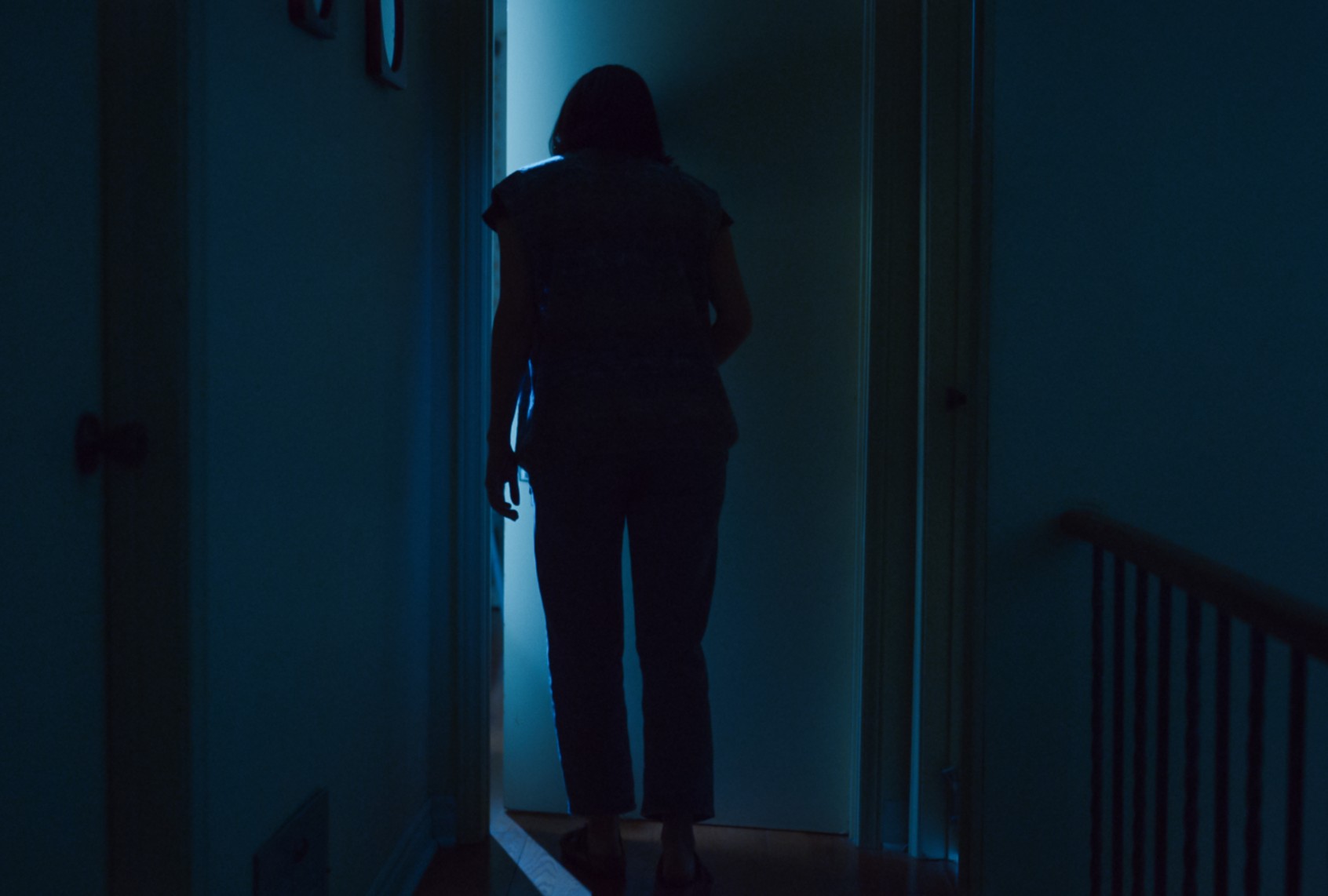
Tuason practically dares the audience to look out from between their fingers, and peer into the black space, hunting for whatever figures might be skulking behind Evy, taunting her with their presence while her back is turned. For most of its runtime, “Undertone” is a new, defining example of economical horror filmmaking. But nothing good can last forever.
“Undertone” is packed with plenty of similarly ridiculous plot points that deflate if you even so much as toss a withering glance their way. But Tuason’s eye for horror framing and ear for chilling sound work make the film’s inane elements easy to overlook — at least for a while. While recording their next episode, Justin tells Evy that he received an anonymous email from a listener, containing 10 audio files with increasingly disturbing content. So, of course, they’ve got to listen to the files together and talk about them for the show. Here, Tuason cleverly lifts a conceit from “The Ring,” where a cursed videotape gave the viewer seven days to live after popping it into the VCR. “The Ring” notably used the tech of its day to disturb the audience, evoking the sense that even the real-life viewer might be cursed just by watching the fictional film, and ratcheting up the tension as the movie moved through each passing day. “Undertone” pulls off this same trick nicely, with pockets of the mysterious audio files sounding genuinely perturbing, causing the audience to expect more scares as Evy and Justin work through all 10 of them.
The concept is simple but wildly effective, with enough force to push the viewer past many of the film’s fatuous elements. One subplot heavily relies on children’s nursery rhymes and playing them backwards to find hidden messages embedded in their melodies. What could easily be a hackneyed story element — how many times have we heard a children’s choir singing an eerie version of “The Wheels on the Bus” over a horror movie trailer? — becomes truly haunting in Tuason’s hands. “Undertone” recalls the feeling of scrolling through the new-millennium internet, seeking out viral scares in horror forums and early YouTube. At that time, there was a pervasive feeling that the internet’s wide expanse and accessibility meant the web must contain things both dark and damning, and the search for nu-tech shocks felt akin to manifesting horror out of thin air, like a child trying to sleep without a nightlight.
Tuason thrusts that sense one step further, framing Evy with plenty of negative space around her. While she records her show and listens to the files at her kitchen table, the camera stays focused on Evy in the foreground, shrouded by the dark foyer behind her. In these shots, Tuason practically dares the audience to look out from between their fingers, and peer into the black space, hunting for whatever figures might be skulking behind Evy, taunting her with their presence while her back is turned. The film makes fantastic use of its single shooting location, tucking horror into every last nook and cranny of this potentially haunted house. For most of its runtime, “Undertone” is a new, defining example of economical horror filmmaking.
But nothing good can last forever. As Evy and Justin work their way through the audio and begin to think that these .WAV files might be more than a prank, one begins to wonder where this could be headed. How much doom can one podcast conjure? As it turns out, Tuason isn’t sure, either. Slowly, “Undertone” reveals itself to be all style and very little substance, with enough baffling character choices to make you groan. If Evy is virtually alone in a house where strange noises are occurring at all hours, what would possess her to put on noise-canceling headphones, other than a death wish? The film’s switch from white room noise to total silence every time Evy puts on her headphones is jarring and effective for the viewer, allowing the film to implement the tricks of its marvelous sound design. But that’s all they are: tricks. When it’s all said and done, and the headphones have lost their charge, there’s nothing more for “Undertone” to do, no ace in the hole final punch to leave viewers breathless. Some crafty artifice and a heap of negative space aren’t enough to fill the void left by a complete lack of narrative sense. Left with no idea how to wrap itself up, “Undertone” throws every one of those horror tropes under a hydraulic press, shoving them together, hoping that the result will be prettier than just polished garbage. It’s only somewhat becoming.
Tech horror is a difficult subgenre to succeed in. Filmmakers are bound by the constraints of the technology or the medium they’re working with. And though “Undertone” makes good use of its podcasting conceit, the format is little more than a crutch for the movie’s narrative to rest on. Unlike other notable films in this space, like Kiyoshi Kurosawa’s cold, computerized “Pulse,” “The Ring” or “The Blair Witch Project,” Tuason’s movie fails to use its primary device to its full potential. But what’s so distinctly frustrating is that it comes close. “Undertone” has all of the elements it needs to be a formidable player in the genre, but reneges the second it approaches singularity, as if Tuason is afraid to commit to what makes his idea special, lest it alienate horror fans who favor conventional methods of scaring the audience. But minimalism and maximalism can’t coexist, at least not here. Instead, “Undertone” is like getting to the climactic moment of your favorite horror podcast, only to have the terrifying impetus interrupted by a Squarespace ad.
Read more
about unconventional horror films


