


For the creator of the short-lived Disney cartoon “Gravity Falls,” necessity was the mother of invention. The show, which ran from 2012–2016, takes place during summer vacation, when twins Mabel and Dipper travel to a small town in Oregon that, according to their great-uncle, Grunkle Stan, “loves Halloween so much they celebrate it twice a year.” The creator of the “Simpsons”–meets–”Scooby-Doo” show, Alex Hirsch, told Polygon in 2024 that the show needed a way to explain the Halloween-themed episode at the end of the show’s first season. And if any fictional town could make twice-a-year-Halloween seem reasonable, it was Gravity Falls, which teemed with paranormal mystery and intrigue.
The increasingly porous boundaries of spooky season have made Summerween feel like the first truly YOLO holiday — whatever you want it to be, at whatever time of summer you want it to happen.
There’s some precedent for fictional holidays becoming real ones: “The O.C.” offered up the interfaith holiday solution of Chrismukkah, “Parks and Recreation” put Galentine’s Day on the calendar, and Festivus, introduced via “Seinfeld,” appears to still be going strong. Still, those holidays do have the benefit of being either a single day or a collection of days that temporally coincide with winter’s existing holidays. Summerween is a different story, in part because there’s no official date for it (though the citizens of Gravity Falls celebrated on June 22) and in part because so many retailers now start stocking their shelves for Halloween as early as July 5. The increasingly porous boundaries of spooky season have made Summerween feel like the first truly YOLO holiday — whatever you want it to be, at whatever time of summer you want it to happen. And, for that matter, whatever you want it to look like.
(MasterShot/Getty Images) Every day is Halloween
Summerween in “Gravity Falls” was more or less the same as regular Halloween — “a night to celebrate pure evil,” as Grunkle Stan puts it gleefully — with trick-or-treating, carved jack-o-watermelons, and a Summerween superstore. There’s a tonal dissonance on Instagram and TikTok, where influencers who see Summerween as a sneak preview of Halloween also hew to its classic aesthetic: Pumpkins, faux gravestones, and coffin and candy-corn-shaped throw pillows, all in shades of black, orange, green and gray. Another faction leans harder on the summer part of Summerween as its own kind of celebration with its own discrete aesthetic: a bright, beachy makeover that nods to pool and tiki parties, with outdoor decor that mashes up flamingos in sunglasses with skeletons in Hawaiian shirts.
Scanning Google Trends, it’s clear that “Gravity Falls” put Summerween on the map, but the early-2010’s spike that marks it is dwarfed by the sharp rise in searches that began in 2024 and have spiked in the two summers since. The most straightforward explanation for its emergence is that, for big-box retailers, the 4th quarter of the financial year is the biggest and busiest, while summer tends to be quieter. Summerween, like “Christmas in July,” offers a win-win on both sides — retailers get a jump on the season, and summer gets a retail glow-up.
But Summerween is also driven by the forces of emotion and nostalgia, which is how Daisy, 44, a marketing professional and mother of two young children, found herself becoming a Summerween superfan. “I dread — underline that, like physically dread — the Thanksgiving/Christmas/New Year’s stretch of winter. I have three siblings, and we all live near each other, and we all have kids, and most of our in-laws are insane about who gets to host Thanksgiving and who gets Christmas and who can outdo the others. The passive aggression and the drama is ridiculous. My parents have basically lost their minds about showing up the other families and now I just try to get through all of it.” Unfortunately, the headache has spread to Halloween in recent years, making it the looming gate to a season of discontent. Daisy started seeing Instagram Reels about Summerween celebrations a year or so back, and had the feeling that adopting it as a kind of private holiday might take the pressure off Halloween. “My daughter’s birthday is in late July, and last year I was like, ‘You know what? Summerween is our family holiday now.’”
And in the broader picture, as the winter holidays have become a yearly source of the most unhinged culture-war inventions — once you’ve seen Tucker Carlson get mad about gingerbread people, you don’t forget it — Halloween feels more and more like a neutral territory (a safe space, if you will) that people want even more of. Summerween, for some of them, is the answer. But marketing Summerween as a stand-alone holiday requires a completely different aesthetic that plays at spookiness but doesn’t totally commit. In other words, spoopy: a once-viral misspelling that was adopted online to differentiate between scary-spooky and performative-spooky (e.g. murder clowns vs. dogs in ghost costumes).
Want more from culture than just the latest trend? The Swell highlights art made to last.Sign up here
Summerween fits the cultural desire, endemic to white conservatives but not at all unique to them, to reconstruct their past rather than the past. I felt that urge the first time I realized how different trick-or-treating with my own child was from my own experience of unsupervised wanderings with a group of neighborhood kids, and how common it had become to not trick-or-treat at all but instead do something called a “trunk-n-treat” that doesn’t involve navigating rainy, poorly-lit streets or interacting with strangers. Had the advent of intensive parenting robbed the holiday of its spark? I barely finished the hackneyed thought. Of course Halloween was better when I was a kid. Because I was a kid.
The question of whether Summerween makes Halloween less special, and whether the calendar year is big enough for two spooky seasons, is personal — but it also speaks to a cultural obsession with consumption.
Unsurprisingly, Summerween is increasingly a source of very strong opinions. On Reddit, gauntlets have been thrown down for seasonal principle (“Part of Halloween is the crisp autumn nights, leaves changing, and pumpkins. Say NO to Summerween!!!!”), environmental harm reduction (“It feels so forced and marketed . . . Half of the summerween stuff at HomeGoods just looks like it will be in a landfill in a year. It just screams fad and consumerist marketing via influencers to sell more”) and for genre consistency (“As a horror fan, summer slashers have always been a thing. However, why are stores selling decorations? That’s ridiculous”)

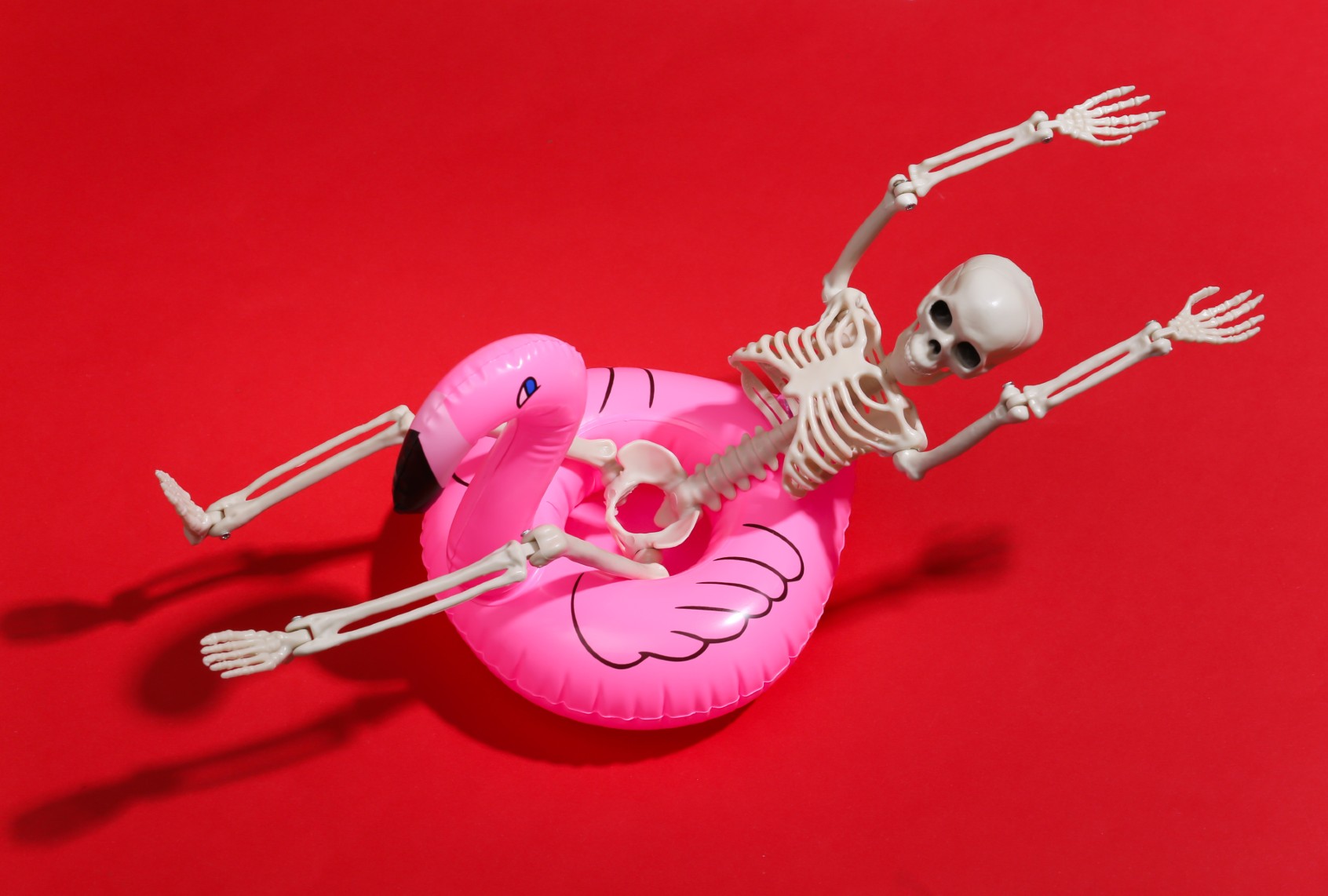
(Vladimir Sukhachev/Getty Images) A skeleton enjoying Summerween
But for a fair number of others, the main objection is that Summerween cheapens Halloween — that to celebrate a summer facsimile will dilute the real thing. Daisy’s husband Matt, for one, feels torn about the spoopiness that retailers foreground with their shelves of pastel pumpkins and rainbow-hued ghosts, and not just because of the aesthetics. “Horror is seasonless, especially now,” he says, pointing to the breadth of horror films, streaming series, and dark-fantasy books that can be accessed at any time of the year. “I’ve always associated horror with summertime, actually. Like ‘Friday the 13th,’ ‘Sleepaway Camp’” — in essence, the freedom of summer invaded by fear and death. “I don’t want my kids to get the idea that they should be afraid of summer, but I also don’t want to have, like, cheesy surfing werewolves be a thing.”
The question of whether Summerween makes Halloween less special, and whether the calendar year is big enough for two spooky seasons, is personal — but it also speaks to a cultural obsession with consumption that has normalized the phrase ‘‘shopping holiday.” A tacit, unquestioning acceptance of any holiday brought into existence by an unholy marriage of social media and big-box stores seems like a slippery slope — in Summerween’s case, one that results in the manufacturing of endless ‘weens to fill the vacuum that consumerism abhors. On the other hand: another holiday that leads to 50% off on candy? I can live with that.
Read more
about holiday economics