


Imagine: You find yourself in the middle of a maze at dusk, trying to make it out before the sun sets, covering everything in a night so blue it erases the corners and horizons, flattening everything into one solid plane that you’re doomed to keep walking until the sun rises again. But the longer the night goes on, the more it feels like the sun might never rise again. Suddenly, the feeling of being trapped is completely consuming. You know the sun will rise again. It always has. Why would that change now? But logic can’t win out — you don’t even remember how you got into this labyrinth to begin with. Every minute feels like an hour, and every hour feels like an eternity. Time slows down to nothing. A radical acceptance of your fate, floating in the void, washes over you. You’re comfortable. And there, lying in that comfortable loneliness, you masturbate.
This is the closest I can come to describing the exact experience of watching “Blue Film,” the outstanding, controversial new indie film from writer-director Elliot Tuttle. The movie, about a cam boy named Aaron Eagle (Kieron Moore) who gets much more than he bargained for during his first visit to his new client, Hank (Reed Birney), is far from your average exploration of power and control. It’s a film that identifies the boundaries we subscribe to and the stories that we let take over our lives, turning us inside out. Rarely is there dramatic action. Instead, Tuttle sits back and allows Moore and Birney to go deeper into this dialogue-heavy two-hander, observing and noting what we do to ourselves and why.
(Obscured Releasing) Kieron Moore in “Blue Film”
I heard from friends that screenings at New York’s IFC Center, where “Blue Film” played for an extended run, had their fair share of walkouts. That’s a shame. To equate discomfort and or brief awkwardness with artistic inferiority is a losing game for those who claim to love movies.
“Blue Film” isn’t easy viewing by any means. But for viewers who enjoy being challenged — who aren’t just looking to watch a film but be shaken to their core by it — there is perhaps no better choice. As much as movies can make us feel good, art also has an imperative to make us think. Over the past year or so, fringe ideas have been commercialized for the mainstream. “Eddington” took on pandemic paranoia and our fraying connection to reality. “After the Hunt” scrutinized the motives behind subjects others wouldn’t dare touch. “One Battle After Another” packaged the revolution into an Oscar-ready box.
But “Blue Film” pushes our minds beyond the political and deeper into the human, as only smaller-scale films like this can. It’s revolutionary because it’s empathetic without an agenda. Its only desire is to remind the viewer that there is so much more out there than meets the eye, and we won’t find it unless we watch and listen, even when it’s uncomfortable.
To Tuttle’s credit, the very top of the film is a great temperature check. If you absolutely can’t vibe with Aaron playing to the camera during a cam show, asking the patrons in his chat which parts of his body they want to smell and taste first, then “Blue Film” might not be for you — at least not right now. (I’d argue there are far more distasteful things in movies currently being marketed to children, but to each their own.) Stick around and persevere through any unease, and you’ll begin to remember, alongside Aaron, that sexuality is both abstract and entirely human. I’d wager that most people seldom sit by themselves and ponder what makes them tick, what causes their engines to rev, or why they like that one specific thing. Americans, especially, are taught to approach sex with hesitation. It’s taboo because we make it so, which means that the legitimately taboo looks all the more repulsive by comparison.
Perhaps that’s why “Blue Film” has resulted in so many walkouts. Tuttle has spoken frankly about his film’s somewhat radioactive reception. The movie was rejected by film festivals that pride themselves on progressive storytelling, like Sundance and SXSW. I heard from friends that screenings at New York’s IFC Center, where it played for an extended run, had their fair share of moviegoers who left the film before its ending, too. That’s a shame, because as Aaron and Hank’s night goes on, their interaction only becomes more compelling. To equate discomfort and/or brief awkwardness with artistic inferiority is a losing game for those who claim to love movies.
Want more from culture than just the latest trend? The Swell highlights art made to last.Sign up here
At first, Aaron believes Hank just wants the standard package, pun intended. But the amount of money Hank is offering for one full night is unprecedented. Aaron’s fans are generous, though, so he’s ready to make it worth Hank’s while. When Hank answers the door in a ski mask, Aaron doesn’t balk. It’s an older guy who doesn’t want to be seen. Maybe he’s married, maybe he’s some closeted celebrity — this is Los Angeles, after all. But Aaron is surprised when Hank says that he’s just interested in talking for a while, and asks to record their conversation. It’s a strange request, but Aaron plays along until Hank asks about the word “diablo” tattooed by Aaron’s eyebrow, a piece of ink Aaron makes explicitly clear he does not want to discuss. When he rises to leave, Hank calls Aaron by his real name, causing Aaron to turn around and rip off Hank’s mask. Aaron immediately recognizes the man standing across from him.
This, dear reader, is where I choose to leave some mystery. If you must know, you can easily find out the nature of this relationship for yourself, but I’d say that you should let that curiosity drive you toward “Blue Film” itself, and not its Wikipedia page. What I will say is that Aaron and Hank haven’t seen each other since Aaron was a teenager, and Hank admits that he’s kept tabs on Aaron and his porn career for a long time. The reason for reconnecting, as Hank puts it, is not only to have sex — though that’s certainly on the table as well — but to find out if Hank is still in love with him, as he was when Aaron was young.

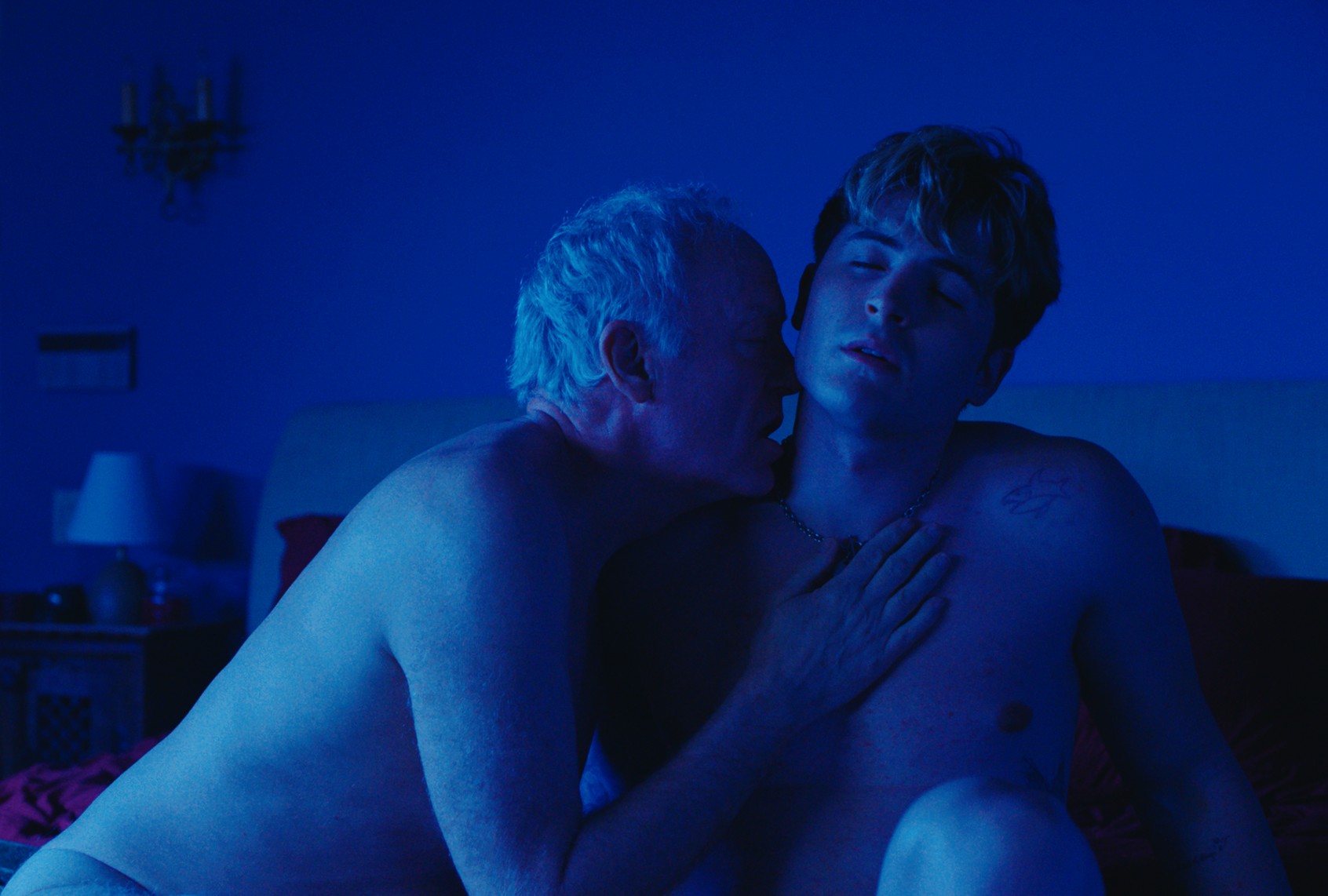
(Obscured Releasing) Reed Birney and Kieron Moore in “Blue Film”
Our want to be desired and our need to be loved often look identical, but they’re worlds apart. And it’s in that space between desire and love where “Blue Film” does its most fascinating work.
For the next hour, the two men engage in a scintillating conversation about their shared past and the lives they’ve lived since their last encounter. Tuttle’s script holds nothing back, burrowing into the darkest, most explicit and controversial corners of human sexuality and making a home there long enough to map its structure. “Blue Film” offers a sympathetic portrait of a man who is a pederast, but not an outright predator actively causing harm to young boys. The distinction is critical to the film’s success. It asks the viewer if they are willing to understand the discrepancy between the two states of being, and where their sympathy begins and ends for someone ashamed of their non-violent, non-predacious sexuality. Even then, Tuttle doesn’t make it so easy. His script is richly layered with character details and heartwrenching backstories that encourage the viewer to go deeper, to spend time analyzing their own discomfort. There’s a satisfaction, even a joy, to thinking at this level. We should be so lucky to experience a film that swerves just when we think we’ve made up our minds.
As the film nears its close, and Tuttle, Moore and Birney all work through the questions of perversion and purity, “Blue Film” pivots once more. Not a hard left turn, but a supplementary detail to take with us in the end. Tuttle doesn’t want to let his audience off the hook when the credits roll, nor should he.
What would it feel like to spend a life understanding that your desire makes you contagious, as Hank does? And in Aaron’s case, what would it be like to reconnect with someone who saw you before you saw yourself, whose observation of you is both perverse and undeniably correct? All those years that you longed to be loved, what if someone told you they did, and you never knew it? It might heal you, or traumatize you differently. Maybe the only way to know is to spend the night talking through it. Our want to be desired and our need to be loved often look identical, but they’re worlds apart. And it’s in that space between desire and love where “Blue Film” does its most fascinating work.
This is the true underbelly of human desire, the one most quote-unquote gritty, R-rated pictures don’t want you to see. Tuttle’s film admits that, very often, sexual impulse is intrinsically linked to trauma, no matter how much we want to believe that we can separate the two in the bedroom. (Or the kitchen. Or the couch. Or on top of the dryer.) And while his screenplay is intentionally incendiary, Tuttle understands that extreme power lies in well-crafted provocation. Rarely are our viewpoints contested, and if they are, filmmakers frequently stop short of probing the truth. “What if you considered this other perspective?” most of them ask, neglecting to realize that most people won’t be inclined to think harder unless they’re presented with more than a suggestion. “Blue Film” demands something of its audience, a token of each viewer. What do you, and only you, think of what you’re seeing? No two experiences with it will be the same, and that variety is where a powerful external dialogue begins.
Read more
about small movies worth a big buzz