


For years, Rep. Tom Suozzi (D-NY) has lived at a Washington townhouse run by the Fellowship Foundation, aka The Family, the secretive group behind a global, right-wing Christian political network.
Known as the C Street Center, C Street house, or just C Street, the building is home to members of Congress who enjoy below-market rental rates and the services of college volunteers, all provided by The Fellowship. Suozzi has assisted The Fellowship’s work, publicly and privately, for most of his time in Congress.
One religious leader told me that Suozzi tried to keep his C Street lodgings a secret. Suozzi’s roommate is Rep. John Moolenaar (R-MI), who has only discussed living there in one religious podcast, but is known as a Fellowship insider and staunch opponent of LGBTQ+ and reproductive rights.
Suozzi is a frequent facilitator of Fellowship network-building, including recently in El Salvador, where he and Moolenaar praised the president, Nayib Bukele, who joined The Fellowship’s ring of prayer breakfasts. Suozzi and Moolenaar sing at Fellowship events with Rep. Tim Walberg (R-MI), who was flown by The Fellowship to bolster Ugandan politicians who enacted an LGBTQ+ death penalty there.
Suozzi’s and Moolenaar’s vague public references to their Washington lodgings match known details about life at C Street. One detail they haven’t mentioned is their rent, $800 each per month. Neither responded to emailed questions about the reporting in this article.
An analysis of House reimbursement disclosures shows that their rent is consistent with C Street rents, and lower than what other Washington renters pay, even in less expensive neighborhoods. One ethics watchdog told me the low rents could constitute illegal gifts.
Suozzi has been a vocal advocate for cooperation and reconciliation with Republicans, working often with Fellowship Republicans. He takes an opposite tack toward Democrats on his left. In The Fellowship, reconciliation typically involves everyone from conservative Democrats to right-wing dictators; seldom journalists or the left.
It’s not known who subsidizes the low rents at C Street, which is technically a church and doesn’t disclose its backers. The C Street Center nonprofit that owns and runs the house is controlled by four Fellowship insiders, all Republican donors, including Moolenaar’s millionaire mentor.
The three-story residence has spawned a variety of scandals over the years. Those include not just ethics complaints about the low rent, but three political sex scandals.
U.S. and other government records suggest C Street remains a hub for international lobbying to this day.
Most visibly, Suozzi has been a leader of The Fellowship’s National Prayer Breakfast as The Fellowship used it to bolster friendly dictators, right-wing allies, accused human-rights abusers, and others.
So, for most of his congressional career, Suozzi’s involvement has helped The Fellowship build right-wing political networks working around the world against LGBTQ+ and reproductive rights and, in some places, democracy. Fellowship leaders and donors have promoted election denial for decades overseas and, more recently, here in the U.S.
Most visibly, Suozzi has been a leader of The Fellowship’s National Prayer Breakfast (NPB) as The Fellowship used it to bolster friendly dictators, right-wing allies, accused human-rights abusers, and others.
Fellowship politics are seldom overt, and sometimes not even intentional. But operating in secrecy, among like-minded people, the results are inevitable. Secular and LBGTQ+ groups have warned Democrats for years about the dangers of helping The Fellowship.
As one of very few Democrats still publicly associating with The Fellowship, Suozzi helps preserve the tattered bipartisan facade essential to its work. (At this year’s Fellowship prayer breakfast, only two Democrats spoke, Reps. Jonathan Jackson (D-IL), son of the late Rev. Jesse Jackson, and Lou Correa (D-CA); Suozzi joined an on-stage singalong.)
Having even just a few token Democrats gives events official-seeming status that The Fellowship exploits, especially in countries where access to members of the U.S. Congress is a liquid commodity.
Leveraging that access, The Fellowship grows regional ministries and prayer networks that quietly glide politicians and nations toward right-wing policies and even theocracy.
Suozzi and Moolenaar co-chair the weekly U.S. House prayer breakfasts, also ostensibly bipartisan but also facilitated by Republican Fellowship associates. (Side note: The Fellowship uses the title “associate” for scores of operatives around the world it supports with administrative services and guidelines, serving as a clearinghouse for the donations they bring in to support their activities. Typically, associates minister to, or “encourage,” powerful politicians while supported by rich people who want access to those politicians or want someone to keep those politicians strong in the face of popular opposition. Sometimes, an associate’s connection to The Fellowship is an open secret, but rarely to the public. The Florida House chaplain and his predecessor are good examples of how this works.)
In January, Suozzi accompanied Moolenaar on a committee junket — even though Suozzi’s not on the committee — as part of The Fellowship’s campaign to boost Bukele.
Accompanied by Fellowship leaders, Suozzi and Moolenaar helped The Fellowship launch a new Salvadoran prayer breakfast there. They lauded Bukele — whose violations of human and civil rights are well documented — suggesting God supports Bukele and urging the nation’s leaders to start their own prayer groups.
“[Y]ou’ve achieved a miracle,” Suozzi said, addressing Bukele directly, “the miracle that’s taken place in El Salvador.”
Civil-rights groups say Bukele’s miracle entailed suspending civil rights and imprisoning thousands of people.
Start your day with essential news from Salon.Sign up for our free morning newsletter, Crash Course.
Suozzi met with dissidents the day before his remarks at the Salvadoran National Prayer Breakfast but doesn’t appear to have articulated their concerns publicly.
Meanwhile, deportations from the U.S. to El Salvador in the first three months of this year roughly doubled from 2025, the Associated Press reported. Investigative reporters this month said Bukele has frozen their assets to punish them for reporting on administration corruption.
Suozzi’s also given time to The Fellowship’s National Student Leadership Forum on Faith and Values (NSLF).
And he follows in the footsteps of past Fellowship Democrats who seemed less comfortable with progressive Democrats pushing economic and social justice than he is with far-right Republicans cutting benefits for the needy and stripping LGBTQ+ and reproductive rights along with voting rights and civil rights.
Last year, Suozzi and Rep. Tracey Mann (R-KS), a Fellowship veteran, appeared together on Fox to call for bipartisanship and reflect on Charlie Kirk’s death.
In 2024, as Fellowship evangelicals pressed Speaker Mike Johnson (R-LA) to support aid for Ukraine, Suozzi pushed Democrats to help Johnson survive as speaker for that purpose. He has assisted the efforts of The Fellowship’s right-wing Ukraine point person, who has floated the dream of a biblically-based Ukraine.
Suozzi last year told Roll Call that the last book he read was “Turnaround” by Sen. James Lankford (R-OK), another longtime Fellowship insider. “He’s a good guy,” Suozzi said.
Suozzi frequently co-sponsors legislation with Mann and other Fellowship Republicans. Outspoken against his party’s left flank, even opposing Democrats’ defensive gerrymandering, Suozzi stays mum about the right-wing efforts of Moolenaar and other Fellowship Republicans.
Suozzi last year wrote an entire Wall Street Journal op-ed about then-mayoral candidate Zohran Mamdani. “For Democrats, Mamdani is a Wake-Up Call — and a Bad Example” has since been deleted from Suozzi’s campaign website.
Suozzi on Moolenaar: “We love each other. And we care about each other. And I know that everything that John does, he does from his heart, because he wants to do the right thing to serve his fellow human beings.” – Jan. 19, 2026, remarks at El Salvador National Prayer Breakfast.
Suozzi on Mamdani: “I can not back a declared socialist with a thin resume to run the most complex city in America. We need leaders who will fight crime, not undermine the police. Who will create jobs, not harm the economy.” – Oct. 29, 2025, post endorsing former Gov. Andrew Cuomo (D-NY) for mayor.
Instead of leveling public criticism against Fellowship Republicans, Suozzi in private lets them use his name on coveted breakfast invitations that empower oppressive right-wingers overseas. And he keeps The Fellowship’s secrets.
That includes the right-wing shadow diplomacy that C Street residents carry out there and at prayer breakfasts around the world.
At the 2020 National Prayer Breakfast, Australian Member of Parliament David Hodgett got to meet Suozzi and Moolenaar, Hodgett disclosed in an Australian filing. Hodgett reported that he “received an invitation from The National Prayer Breakfast Host Committee.” In fact, Fellowship associates choose most guests.
Government filings show that the C Street Center is known by foreign nations as a nexus for lobbying, and has been used for that purpose, including during Suozzi’s time there.
The C Street donors who subsidize Suozzi’s low-cost living arrangements remain unknown, but The Fellowship has supported C Street financially while getting millions of dollars from right-wing evangelicals. Franklin Graham’s organization Samaritan’s Purse link has reported donating to The Fellowship, but at the C Street address.
Suozzi’s Fellowship history
It’s not clear how long Suozzi has maintained a room at C Street.
He came to Congress in 2017, living at first in an apartment with other members of Congress and staff. A Fellowship document I obtained shows he was at the National Prayer Breakfast by February 2018.
In October 2019, he and Moolenaar co-chaired the NSLF, the Fellowship student program that churns up potential congressional interns and Fellowship stars.
Four months later, co-chairing the February 2020 National Prayer Breakfast, Suozzi and Moolenaar referred to rooming together.
The Rev. Rob Schenck, a former Christian nationalist who once ministered to the right in Washington, told me that Suozzi said at the time that he was living at C Street. And didn’t want people to know it.
This was the week after the 2020 breakfast.
Schenck met Suozzi on Feb. 10, 2020, on a train. Schenck spotted Suozzi reading a book by the prayer breakfast’s keynote speaker. (It was Arthur Brooks’s “Love Your Enemies,” the command of Jesus that President Donald Trump publicly rejected at the breakfast.)
Suozzi and Schenck discussed C Street. Suozzi confided that he lived there, secretly. “He said to me, I don’t tell anybody this,” Schenck told me.
Schenck paraphrased Suozzi’s remarks: “I don’t tell anybody this, but, you know, I’ve been, I bunked up at C Street.”
At the time, Schenck hadn’t publicly broken with the right. (Two years later, Schenck would make headlines as a “dissenting evangelical” revealing how he and his “stealth missionaries” had ministered to Supreme Court justices; pushing the court to the right.)
But on that day in 2020, as Amtrak sped them from New York to Washington, Schenck was still known as an evangelical minister to powerful conservatives. That’s why Suozzi shared his secret.
I asked Schenck whether he thought Suozzi used living at C Street to establish his bona fides with a minister known then as a right-wing evangelical.
“Oh, yes,” Schenck said. “He knew I was an evangelical minister. He knew what I had done on the Hill. And he was kind of assuring me, ‘Hey, I may be a Democrat, but, you know, I’m in the family,’ so to speak.”
Suozzi said Schenck wanted to keep C Street quiet, to have it both ways. “He said, you know, I don’t talk about it, but: ‘Good experience,’ or words that effect,” meaning: Life at C Street.
Schenck said, “It was just, he was trying to assure me, you know, ‘I’m in. I’m in the family; good people, you know. I live both worlds.’ That sort of thing.”
Suozzi wanted to keep it that way. He was “guarded” about C Street, according to Schenck. “He was protective of that information,” Schenck said. “He definitely didn’t want that order of, you know, publicity. He wanted just to say to me, ‘I’m a good guy.’
The men stayed in touch for a bit, by email. “He was surprising to me,” Schrenck said. “I thought of him as, you know, stereotypical, progressive Democrat, and then realized, wow, he’s got some conservative sensibilities.”
As for C Street, Schenck said, “He was connected there.”
In 2022, Suozzi opted not to run for re-election, running instead, unsuccessfully, for New York governor.
By the time he returned to Congress in early 2024, the House was reimbursing members for lodging expenses in Washington. A House disbursement report shows Suozzi paying $800 per month for lodging starting in March 2024.
It’s possible Suozzi never gave up his C Street bunk while he was out of Congress. Or he found an open room there within two months of returning to Washington. Or C Street kept his old room vacant for him.
Whatever happened, he and Moolenaar are still roommates.
House rules don’t require members to disclose where they stay in Washington or to whom they make out their rent checks, but the quarterly disclosures show Suozzi paying what others at C Street pay, including Moolenaar.
The Michigan Republican also paid $800 per month the last two years. But an earlier House report shows Moolenaar paying just $600 per month in 2023, suggesting that Suozzi, his roommate, paid a similar rate prior to his hiatus.


According to his alumni magazine, Suozzi got involved with the prayer breakfast specifically to connect with Republicans.
“You can only solve complicated problems when you have people of goodwill who are willing to sit down with one another and work together to try and find common ground,” Suozzi claimed, although American history is replete with counter-examples and Suozzi’s own history reveals a different approach toward the left.
(The myth of prayer yielding productive unity is a long-standing canard of The Fellowship, a one-way ratchet used to move moveable, or sympathetic, Democrats.)
Suozzi’s ties to The Fellowship don’t appear to have lapsed at any point, even during his year out of Congress.
Suozzi’s breakfasts
The Fellowship document I obtained, a spreadsheet of attendees, shows that Suozzi attended the 2018 National Prayer Breakfast solo. (Every member of Congress is invited.) And it lists who else was there.
The spreadsheet shows that Suozzi shared his table with four guests invited by Doug Burleigh, a longtime Fellowship leader focused on Russia, Ukraine, and other former Soviet republics. (Burleigh achieved brief notoriety when it came out that his 2017 guests included Russian operatives Maria Butina and Alexander Torshin.)
By 2019, Suozzi’s roommate, Moolenaar, was part of C Street in some fashion. A picture posted online that year shows Moolenaar hosting Ohio Christian University students at C Street, along with Donna Rice Hughes.
When Suozzi and Moolenaar co-chaired the 2020 breakfast, Suozzi wasn’t just reading a script. He helped The Fellowship put together the program; he said he had asked Rep. John Lewis (D-GA) to participate.
It fell to Suozzi and Moolenaar that year to address Trump using the event to flaunt his acquittal by the Senate, reject the teachings of Jesus, and eviscerate Fellowship claims about the unifying power of prayer. The first-hand evidence of Trump’s performance left Suozzi unswayed in his certainty about faith.
The Fellowship’s religious claims are never disproved, history suggests, just yet to be proved.
“Not everybody seems to get it yet,” Suozzi said after Trump left. “But we’re not gonna give up, are we? … [W]e’ve gotta keep on pushing the message of love.”
That was six years ago. Suozzi’s prayer prescription appears even less supported by evidence today.
Not only has Trump — and arguably The Fellowship — made religion in America more divisive, The Fellowship itself is now in a legal battle with its own breakfast spinoff. The fight is almost funny: Two Christian groups, who claim prayer breakfasts are unifying, now divided by them.
Also in 2020, Suozzi and Moolenaar hosted a Zoom meeting for that year’s NSLF, speaking with foreign students. One posted on LinkedIn about being sponsored for the event by Fatmir Mediu, an Albanian government official and longtime Fellowship insider.
The two roommates also co-chair the weekly Capitol Hill Fellowship prayer breakfasts. “Today’s breakfast is really an extension of what John and I do every Thursday morning at 8am in the Capitol,” Suozzi said at the 2020 NPB. “We gather with our House colleagues … for our weekly House prayer breakfast.”
Belying the ecumenical veneer of their breakfasts, Suozzi and Moolenaar made their prayer sectarian: “Christ, our lord.”
Suozzi would co-chair the national breakfast again, on video in 2021 due to COVID.
In 2022, he and Moolenaar were listed as part of the sham House committee on the annual invitation that makes it appear that Congress runs the event. Those invitations help Fellowship allies overseas convince local media of their importance in the U.S., building their prestige at home and increasing their value to monied interests seeking connections to U.S. members of Congress.
Things got interesting in 2023. Suozzi was no longer in Congress. The prayer breakfast had split in two. Nevertheless, The Fellowship’s iteration of the breakfast — same place, same time — was once again co-chaired by Suozzi.
Suozzi didn’t co-chair in 2024, but the invitation bore his name again, a federal filing shows. His name, too, graced the card attendees got.

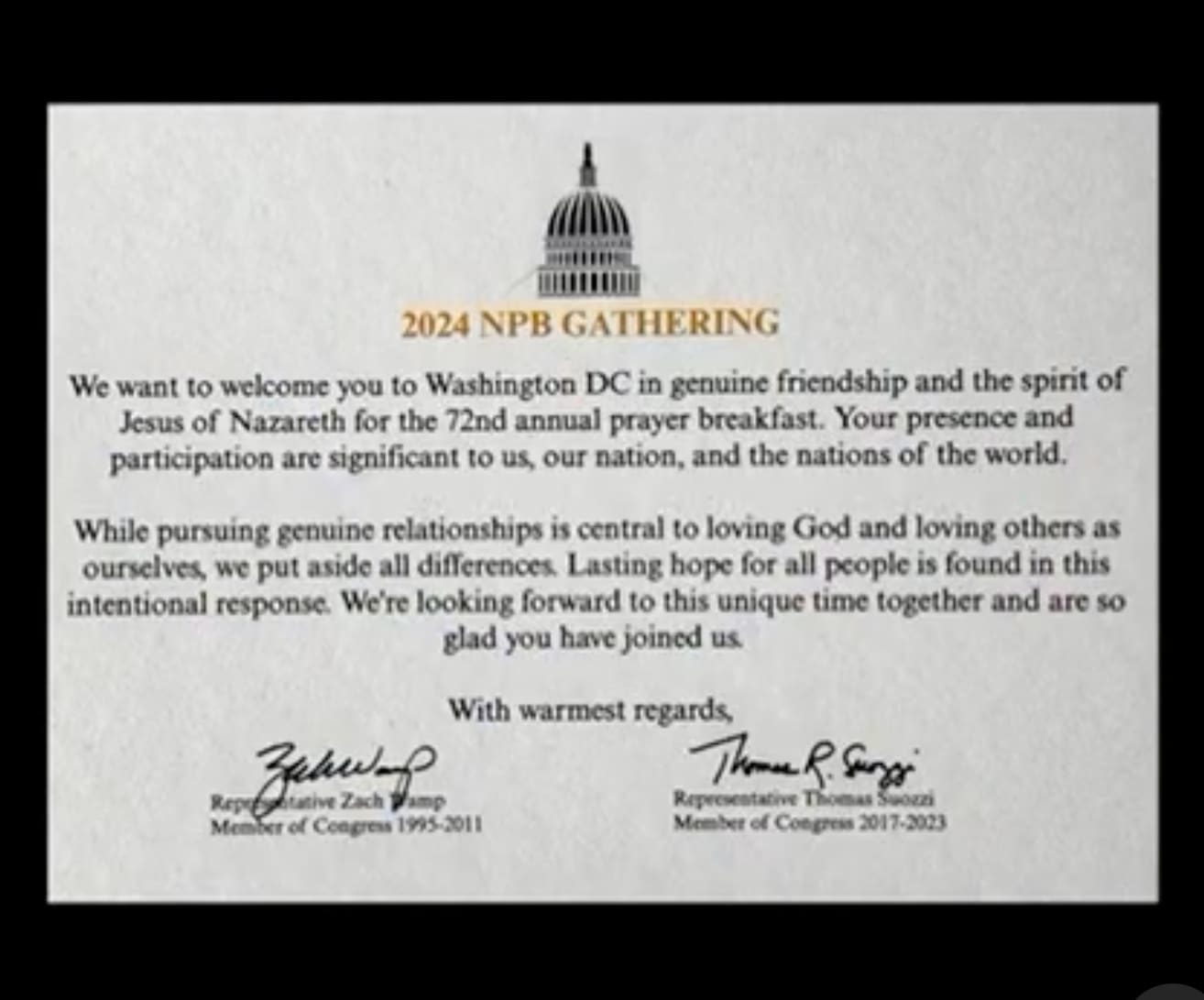
Guests got that welcome card the day after Rep. Mark Pocan (D-WI) issued a press release demanding answers from The Fellowship about its prayer breakfasts and ties to Uganda’s LGBTQ+ death penalty. Some of the people behind that law were among the guests Suozzi invited and welcomed to that year’s breakfast.
The same thing happened the following year: Suozzi didn’t co-chair in 2025, but his name was on the invitations, which aren’t made public unless they’re obtained by journalists or appear in government filings related, for instance, to visa applications or foreign-agent registrations.
As usual, Fellowship insiders in other countries puffed up their status at home last year by saying they’d been invited by Congress or even the president.
When local media in Bangladesh followed up, the U.S. embassy issued a denial. Journalists trying to sort it out ultimately identified Suozzi and others as signing the invitation.
This year, again, Trump used the breakfast to reject the unifying power of prayer that Suozzi swears by. Religious people, Trump said, shouldn’t vote for Democrats.
All but three congressional Democrats had already got the message. Jackson co-chaired. Correa read from Scripture. Suozzi joined the choir. That was it.
The prior month, though, in El Salvador, Suozzi and other Democrats were front and center at Bukele’s breakfast. That trip had The Fellowship written all over it, literally, in the case of an itinerary I obtained.
One event was explicitly listed as “‘C Street’ format.” The trip’s travelers presumably knew what that meant.

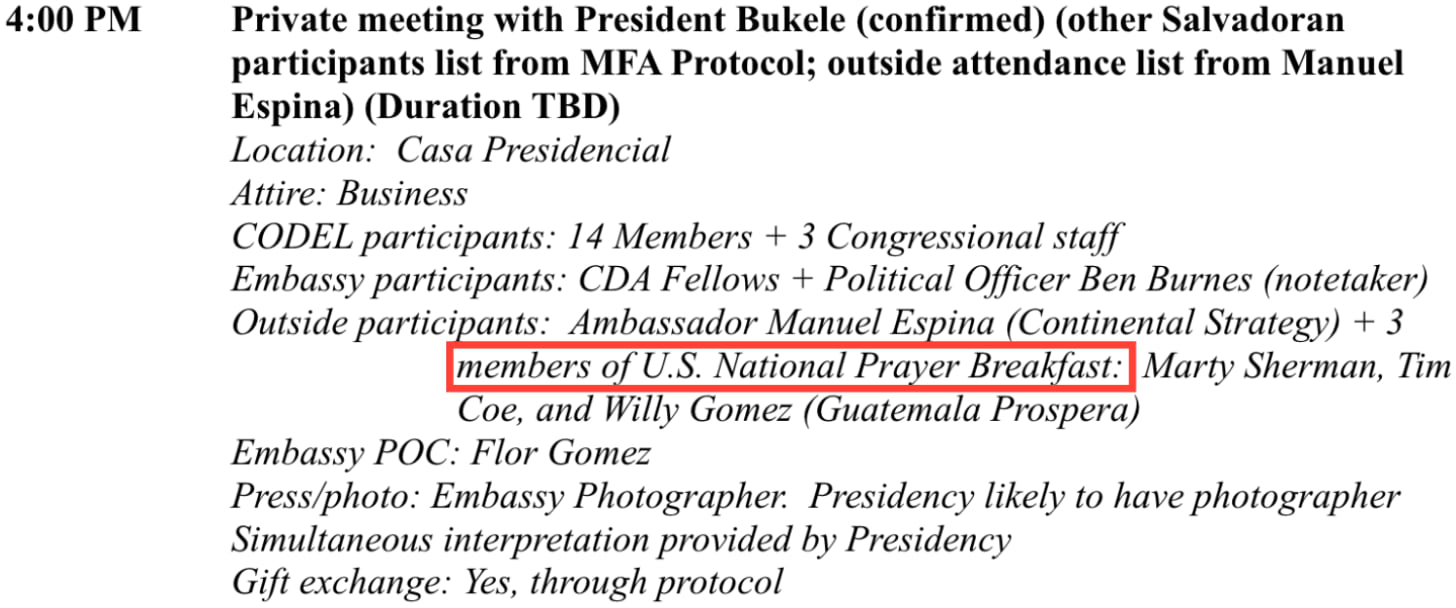

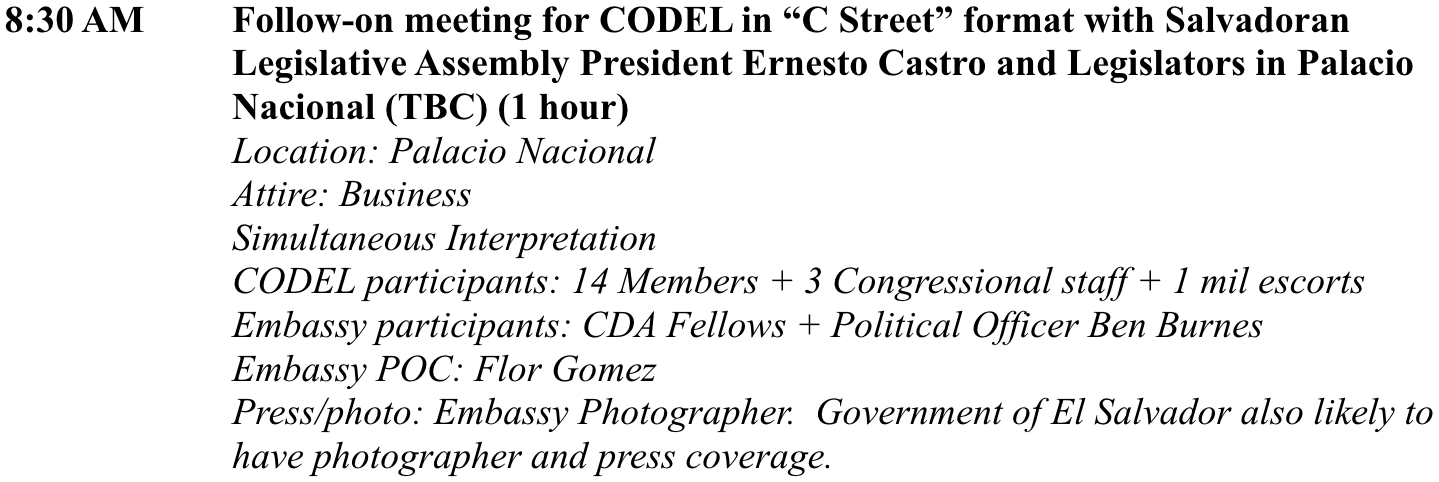
Suozzi wasn’t the only member of Congress who didn’t sit on the committee but did sit down for Bukele’s prayer breakfast. As I’ve previously reported, the itinerary included non-members of Congress active in The Fellowship.
Lobbyist Manuel Espina, a past ambassador from Guatemala to the U.S., was there. (The Fellowship tends to stick with official honorifics for its insiders, long after they become lobbyists.)
Espina, as the itinerary indicates, is now a lobbyist for Continental Strategy. That firm is part of ongoing efforts, orbiting The Fellowship, to pump U.S. money into regional companies that have supported The Fellowship.
Espina’s also the founder of Guatemala’s National Prayer Breakfast and a key architect of Fellowship machinations that rescued Guatemala’s evangelical president by taking out a UN anti-corruption task force.
Here’s Espina and then-President Jimmy Morales, along with Sen. Mike Lee (R-UT) and other Fellowship insiders, at C Street in an undated photo. Suozzi posed with Espina the following year, as Fellowship efforts to gut the UN task force was under way.
If Suozzi didn’t know at the time that Morales’s government was working to undermine the task force, he probably should have. The subject came up more than once at House committee hearings Suozzi attended prior to his picture with Espina.
Espina’s colleague from the Guatemalan branch of the National Prayer Breakfast, Willy Gómez, appears in the January 2026 trip itinerary as a “member” of the U.S. National Prayer Breakfast, as highlighted in the excerpt above. The other two members are straight from C Street.
Marty Sherman is the guy who runs C Street. Tim Coe is Sherman’s college buddy and the son of deceased Fellowship leader Doug Coe. Together with Tim’s brother, David, Tim-David-and-Marty are practically spoken of as one word as Fellowship leaders, a Fellowship source once told me.
Start your day with essential news from Salon.Sign up for our free morning newsletter, Crash Course.
Why was half the C Street leadership at a congressional meeting ostensibly about China in El Salvador with the president? The itinerary doesn’t offer even a token explanation. But it’s not hard to guess.
The Salvador leg of the junket had little to do with China. China wasn’t mentioned at the breakfast. The Fellowship members of Congress didn’t sing the praises of America’s influence.
The real influence was Jesus. And C Street.
Moolenaar said “we treasure” the Declaration of Independence, but didn’t say why, and spent more time extolling the virtues of prayer breakfasts.
Suozzi told Bukele and other Salvadoran politicians — except opposition leaders barred from the breakfast — not about the beauty of dissent and free speech or the wonders of checks and balances, but about the importance of praying together.
“This is such a wonderful occurrence that you are celebrating this first prayer breakfast like this, bringing together so many people of different faiths and different political beliefs, all united in the spirit of prayer to make your country and our world a better place…
“Don’t underestimate the power of getting together with each other in small groups, of spending time with each other, of getting to know each other, of building relationships.”
(Note: Opposition leaders were excluded.) That’s the Fellowship model for building influence; unaccountable, outside public view.
As Schenck explained to me, the U.S. prayer breakfast is for spotlight-seekers, while C Street is for the publicity-shy. The Salvadoran breakfast blended the two, a stage outside the U.S. spotlight, with Suozzi navigating the overlap awkwardly as he and his fellows sang The Fellowship’s praises, without naming it or divulging many details.
“We live in the same house in Washington, DC,” Moolenaar said, without saying which house, “and we also have dinner together on Tuesday nights and some of our colleagues will tell you more about those dinners.”
C Street is known for its Tuesday group dinners, but not much was said about them after Suozzi redirected Moolenaar, saying: “I think you should tell everybody about our prayer breakfast and what happens in the United States.”
After that, the closest anyone came to the Tuesday dinners was Lee, the Utah Republican. He said, “When we meet every Tuesday night, we cease to be senators or congressmen. We cease to be Republicans or Democrats. We gather as children of Jesus, as brothers and sisters in Jesus.” It was a C Street telltale, but Lee only shared it in Spanish.
No one said “C Street” in any language.
Jan. 19, 2026 — El Salvador National Prayer Breakfast
Suozzi’s Jan. 20 Instagram post about the trip didn’t mention the previous day’s prayer breakfast or Bukele.
A week later, amid horror over the death of Renee Good, Suozzi apologized for funding Immigration and Customs Enforcement (ICE) but said nothing about having just celebrated Bukele, who provided ICE with torture cells, offered to hold Americans there for Trump, and taunted a U.S. judge who tried to block deportation flights.
Moolenaar’s committee only issued its press release about the trip after I inquired.
The power of prayer
Suozzi and Moolenaar kicked off the 2020 NPB with a running shtick — juxtaposing their backgrounds. Typically in these Fellowship comedy routines, the Democrat is the punchline; urban weirdness juxtaposed with wholesome Republican normalcy.
“I have 15,000 farmers in my district,” Moolenaar told the audience.
Suozzi took the handoff: “I know a guy named Farmer.” (Suozzi represents parts of Queens and Long Island, which has farmers.)
There were no jokes about Suozzi’s constituents making twice what Moolenaar’s do. But there were more jokes at the expense of Suozzi and his constituents.
Moolenaar: “In my district, the kids have the first day of deer-hunting season off from school.”
Suozzi: “In my district the kids have off for Yom Kippur.”
Moolenaar redeemed Suozzi, absolving him of any New York weirdness. “Despite all of our differences,” Moolenaar said, “Tom and I are good friends. In fact, we’re roommates.”
Suozzi added, “We even share a bathroom together. He’s very neat.”
Without Suozzi telling us, it’s virtually impossible to know whether C Street Republicans have moved Suozzi further right. History suggests they’ve tried, as they have with others.
According to Suozzi, Moolenaar’s politics — stripping reproductive rights, expanding anti-LGBTQ+ discrimination, not to mention immigration policies, voting rights, election denial, and Trump’s illegal wars — come from a good place.
“I know that everything John does, he does from his heart,” Suozzi said as they celebrated Bukele’s presidency, “because he wants to do the right thing.”
Suozzi is also friendly with Bishop Robert Barron, a Fox pundit who’s on a Trump religious commission and spoke at Trump’s “Rededicate 250” event celebrating theocracy and Christian nationalism.
Barron has also appeared with Ben Shapiro and on a Tucker Carlson episode about “the foolishness of atheism.”
In an April 14 op-ed, Barron lamented persecution of Christians by secularists. (That same day Barron found himself defending Pope Leo XIV against Trump calling the pope weak on crime.)
Suozzi responded to Trump’s critique of the pope by blaming normalization of Trump, without noting his own normalization: Celebrating Trump at prayer breakfasts and claiming prayer will bring unity.
Suozzi’s defense of the pope offered an illuminating contrast with Suozzi’s call for Democrats not to defend much less powerful people here in the U.S.
He blamed 2024 Democratic losses on Democrats defending transgender people. He called transgender girls “biological boys” and lamented the party’s attempts to be “politically correct.”
In the same interview, Suozzi amplified Republican narratives about “anarchy on college campuses, defund the police, biological boys playing in girls’ sports, and a general attack on traditional values.” He didn’t say whose traditional values.
Before Gov. Kathy Hochul (D-NY) endorsed Suozzi in 2024, she reportedly grilled him on his commitment to reproductive rights and got him to pledge not to run ads against his own party.
The 2024 Democratic National Convention tapped Suozzi to talk tough about the border and undocumented immigrants. Suozzi then backed the 2025 Laken Riley Act that weaponized Trump’s immigration enforcement.
Later, of course, Suozzi joined in the right-wing fear-mongering about Mamdani, even after his own party chose Mamdani as its mayoral candidate.
Suozzi does reliably defend one group: Christians. In a video during the Jan. 6 attacks, as self-described Christians rampaged through the Capitol brandishing Christian imagery and slogans, Suozzi fretted about “anarchists on the left.”
“We have a major problem in our country with white nationalism, white supremacy, and far-right militia groups, and we have concerns about anarchists on the left, as well.”
He didn’t mention Christian nationalism.
I asked Schenck whether his gradual shift, seeing Suozzi as more conservative than he did at first, might have been due to C Street’s influence. Schenck told me he couldn’t say that.
“I didn’t know him long enough to see a trajectory,” Schenck said. “I read it as just getting to know him better.”
This post originally ran on The F**king News. Read the original post here.
Read more
from Jonathan Larsen