

Of all the things I am absolutely certain I’d make a shambles of, writing a memoir and being one-third of a throuple are in the top five. Therefore, I’ve read the responses, rants and assorted hot takes that emerged from the recent publication of Lindy West’s new memoir, “Adult Braces,” with a mix of anxiety and frustration. If you’re familiar with West’s body of work, which comprises a memoir and two essay collections, you know what to expect from the book: honesty, profanity, self-deprecation and reckonings with a painful past, to start with. Reading it, I kept thinking about a classic bit of advice on personal writing: Write from the scar, not from the wound. I loved reading “Adult Braces,” but there’s no question that it’s a book that feels, for lack of a better word, unhealed right up until the end — when, suddenly and decisively, loose ends are wrapped up in a tidy and happily ever after.
What did you think? I texted a friend who had also just finished reading. Hours later, a response came through: “Lindy, blink twice if you need help.”
The internet of the 2010s was full of hilarious women, and West stood out. To say she had a voice doesn’t capture the appeal and immediacy of her writing, which covered everything from fatphobia and rape jokes to wellness culture and abortion. It was a time when the most reliable way for young woman writers to get a career foothold was to cheerfully open a vein and spill personal stories (the weirder and more humiliating the better) onto one of the so-called ladyblogs that would dispense a cool $50 in return. West perfected the form, and her first book of personal essays, 2016’s “Shrill,” was an instant classic. (It was adapted into the show of the same name on Hulu, which ran for 3 seasons.) She was a fat woman pointing out how fat people are treated, a feminist writing about misogyny, a comedian who wanted comedy to suck less. And her willingness to square up with the uglier aspects of internet culture made her a target of its ire — which, in turn, she also memorably took on.
“Adult Braces” gives voice to the reality behind that fearlessness, which was often one of exhaustion and demoralization. Being a public person who non-public people depend on to tell it straight is also work, and West took it seriously: “Modeling defiance became a 24-7 project that I could not put down without betraying my people,” she writes. “I had to love my body unequivocally, forever, exactly as it was, or else. We couldn’t trust the wider world with any nuance. We couldn’t say, ‘Sometimes I feel bad in my body.’ The thin people would only slip through the cracks with their skinny little knives and say, ‘See?’” That said, the media rollout for “Adult Braces” is focused on the book’s sexier, splashier subject matter (polyamory, if you haven’t heard by now), and what has unfolded is a real conundrum: What happens when the readers who love your personal writing suddenly want to save you from the people you’re writing about loving?
(Gregg DeGuire/Getty Images for the 45th Annual HUMANITAS Prize) Ahamefule Oluo and Lindy West
West and her husband, Ahamefule Oluo, took their polyamory public in 2022, in a StyleLikeU interview that introduced the third person in their triad, Roya Amirsoleymani. It’s not easy to watch West’s introductory statement — “we’re three sweeties” — as it’s eroded by the video’s awkward body language, palpable tension and her own tears. “Adult Braces” adds much-needed context to this interview: West sets off on her cross-country trip in large part to put space between herself and the impasse at which her marriage has arrived — Oluo wants to have an open marriage, West doesn’t. As she makes her way to Florida, West drops new little bombs of context every few chapters: The marriage is already open; there’s a girlfriend; actually, there are two girlfriends. She recalls arguments, ultimatums and guilt trips. (Oluo, who is biracial, suggests that monogamy is not unlike being owned.) West is asking readers to take her at her word one minute, admitting to unreliable narration the next. It’s not surprising that so many Substack essays, YouTube comments and social-media posts have taken on the furious, we-ride-at-dawn urgency that has characterized so much of West’s own writing.
What happens when the readers who love your personal writing suddenly want to save you from the people you’re writing about loving?
There’s been eye-rolling and empathy, anger and confusion; West has been labeled a doormat, an enabler, a benighted sugar mama, a cautionary tale. Until a few days ago, though, no one had accused her new book of driving a nail into the coffin of a social movement, but of course it didn’t take long for for that to change; and in The Atlantic’s March 23 piece, “The death of millennial feminism,” journalist Helen Lewis comes to the same conclusion that so many other outlets over the years have identified when surveying the personal choices of individual women: Well, you’ve done it again, ladies. You’ve gone and killed feminism.
Want more from culture than just the latest trend? The Swell highlights art made to last.Sign up here
Lewis’ piece is nominally about Lindy West and “Adult Braces,” but it’s much more about the author’s longstanding beef with identity politics. Lewis isn’t wrong that West was both a catalyst for and a casualty of a time when “the personal is political” was misunderstood to mean that every personal choice should be politicized. But there’s a sneering edge to the glee with which she declares that Millennial feminism is dead (which it isn’t) — an echo of the directive given to Newsday reporter Marilyn Goldstein about reporting on the women’s movement in 1970 (“Get out there and find an authority who’ll say this is all a crock of sh*t.”), an eternal, recursive impulse to see feminists knocked down and put in their place.
In the content-hungry attention economy, memoir is a feedback loop, and even a successful memoirist cannot write an all-caps afterword with the words I SAID WHAT I SAID and call it a day.
One day back in 2000, I woke up to a weird noise that I later realized was the sound of resentful journalists across the world cracking their knuckles in unison before reporting as snarkily as possible that 66-year-old Gloria Steinem had gotten married. Headlines like “Anti-marriage icon finally ties the knot” and “Gloria Steinem eats her own words” were sent giddily out into the world to suggest that Steinem, with one civil ceremony, had nullfied everything she’d ever stood for. It was a case of False Feminist Death Syndrome, a term coined around the same time by media critic Jennifer L. Pozner to describe the phenomenon of media outlets declaring that feminism had died, or was dead, or was about to die, or was long dead but also still incredibly dangerous, like a zombie in an “Ask Me About My Feminist Agenda” T-shirt. The last blowout funeral for feminism happened in the spring and summer of 2022, when the Supreme Court’s Dobbs v. Jackson decision inspired several weeks of crocodile-tear headlines like “The failure of the feminist industrial complex,” “Is feminism in its ‘flop era’?” and the all-timer “The future isn’t female anymore.”
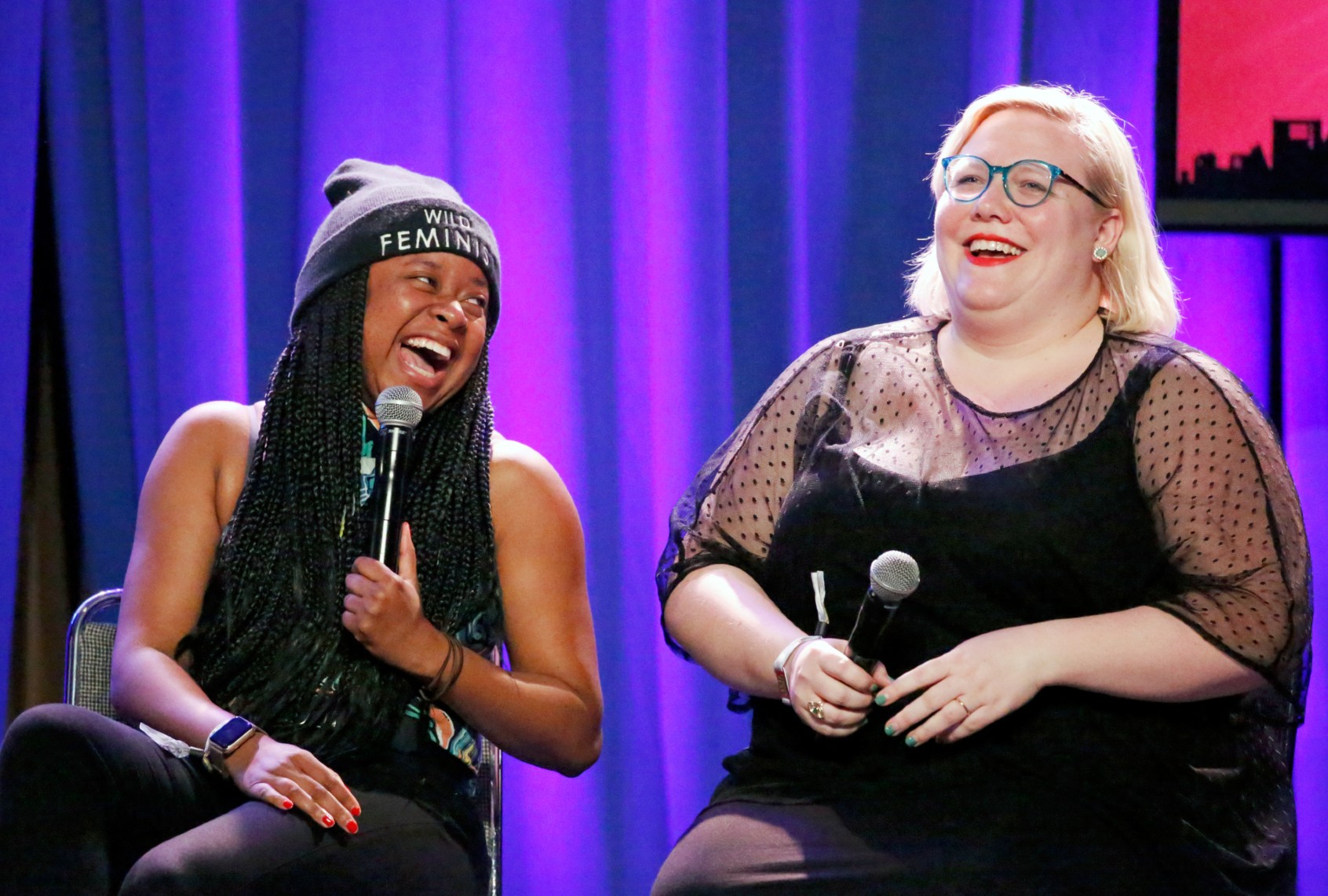
(FilmMagic/Getty Images) Phoebe Robinson and Lindy West perform onstage at the Larkin Comedy Club during Colossal Clusterfest
So it’s not surprising that Lewis saw the discourse swirling around “Adult Braces” and saw the chance to jump back onto a faithful hobby horse. (More than one, actually: She makes sure to get in a few digs at gender-affirming medicine and GLP-1s as well). It doesn’t matter how silly or inaccurate the death note is when there’s always an audience ready to dance on the grave: As one hopeful YouTube commenter suggested, “Maybe [West] was wrong about abortion and body positivity, too, and all the other stuff she believes in so hard.” As Rebecca Solnit wrote recently, two specious assumptions keep the funeral procession going: “One is that we’re at the end of the story, the point at which a verdict can be rendered and a moral extracted . . . if feminism has not won, surely it has lost.” The other presumes “that one event can be a weathervane, a measuring stick, for the failure of feminism . . . The perfect is the enemy of the good, and it’s often both an impossible standard and a cudgel used to bash in what good has been achieved.”
It seems to me, as a frequent reader of memoirs, that the job used to be a little more forgiving. In the analog era, you told the stories, dropped the necessary titillating details and kept it moving: What other people thought about you was none of your business. In the content-hungry attention economy, memoir is a feedback loop, and even a successful memoirist cannot write an all-caps afterword with the words I SAID WHAT I SAID and call it a day. There’s the necessary cycle of promotion, the social-media strategy, and the parasocial fans who seek out subtext from which to create more discourse. And in West’s case, there’s the reality that the person you love decides to impose their own narrative. “In many ways, my side of the story is easier to understand than Aham’s,” West writes. “Mine hews to cultural norms about heterosexual love and relationships while his challenges them.” (Oluo now uses they/them pronouns, but did not when the book was written.)
Oluo’s own PR offensive has only made West’s work more thankless, but her situation is not a referendum on feminism any more than it’s an indictment of polyamory (another institution whose implosion is often treated like a spectator sport. Unfortunately, what’s getting lost in all this noise is the fact that “Adult Braces” is” neither a book about polyamory nor a handbook for others to live by. If we want West’s next book to be written from the scar and not from the wound, we have to trust that she knows what will start the healing.
Read more
about women and writing


