


On a rainy evening in early May, several armed ICE agents in tactical vests closed in on a small red sedan at a gas station in South Nashville. The driver, a frightened 55-year-old Salvadoran man named Edgardo David Campos, gripped the steering wheel while bystanders took out their phones and began recording video. As agents pulled the driver side door open, one of them placed his hand on his holstered pistol. An onlooker yelled, “Do you have a warrant? Let him go!”
The agents soon dragged Campos from his vehicle, handcuffed him, and forced him into the back of an unmarked black SUV. He remained silent, with an expression of bewilderment and terror, as the growing crowd called out to him and the arresting officers.
Nearby, the Tennessee state trooper who had pulled him over stood watching, his squad car parked behind the red sedan. One of the bystanders shouted questions at him, wondering why he had stopped Campos in the first place. Another woman demanded the trooper’s name and badge number, before asking, “Where are you taking him?”
The trooper remained silent. “I don’t have to give you anything,” an ICE agent responded to the crowd. Within minutes, the agents and state trooper drove off, leaving Campos’ car abandoned at the gas station.
By now, the scene has become familiar in communities across the country. The federal siege of Minneapolis—in which masked deportation forces from multiple agencies terrorized immigrants, clashed in the streets with community members, and killed observers Renée Good and Alex Pretti—was the latest in a series of attacks on blue states, including previous high-profile campaigns in Los Angeles and Chicago. Democratic governors like California’s Gavin Newsom and Illinois’ JB Pritzker have lashed out at President Donald Trump and his administration, claiming that it is illegally occupying states and violating the Constitution.
For nearly a week in early May, state troopers roved the city’s Latino neighborhoods at night, with ICE officers riding shotgun and undercover vehicles following behind.
But in Tennessee, where Republicans hold a supermajority in both state legislative chambers, many elected officials have welcomed ICE with open arms. GOP Gov. Bill Lee and other state leaders have touted their close working relationship with White House deputy chief of staff Stephen Miller, the architect of Trump’s deportation campaign. As part of this collaboration, they have paired state police with ICE agents, deployed national guard, and green-lighted the federal occupation of Memphis under the “Memphis Safe Task Force,” which, as Mother Jones’ Samantha Michaels reported, residents compared to living in “a war zone, with helicopters circling over neighborhoods, National Guard officers patrolling downtown, and unmarked law enforcement vehicles in the streets.”
Campos’ arrest was part of a May operation in Nashville, dubbed “Operation Flood the Zone,” that could become a template for future incursions into Democrat-run cities in Republican-controlled states. For nearly a week in early May, state troopers roved the city’s Latino neighborhoods at night, with ICE officers riding shotgun and undercover vehicles following behind, leaving fear and panic in their wake. During the operation more than 600 vehicles were stopped, and ICE claimed that nearly 200 residents were arrested.
State troopers used pretexts such as bent license plates, unlit temporary tags, and dark window tints to pull people over, so that ICE, which can’t make routine traffic stops, could check their immigration status—and bypass constitutional and legal protections in the process. During the stops, some ICE agents carried assault rifles and “window punches,” in case a driver refused to roll down their window.
As the operation unfolded, Nashville’s Democratic city leaders, who had not been notified in advance, scrambled to understand what was happening. Anguished families searched for missing loved ones, children were left alone at home because their parents never returned, and terrified families went hungry for fear of leaving the house and being targeted. Businesses watched their sales plummet and clients disappear.
Zulfat Suara, a Nashville council member at large, said that as the operation unfolded, “lives were thrown into shambles. There was no due process; people weren’t allowed to see their attorneys. And we didn’t know what was going on.” An immigrant herself from Nigeria, Suara was the first Muslim to be elected to Nashville’s city council in 2019. Since the May ICE operation, she said, she now carries her US passport with her wherever she goes because Black and brown people are being deliberately targeted. “You just have to fit the profile,” she said.
Nine months after the state and federal operation, Nashville residents are still searching for answers about who was taken, and the role that Tennessee played in targeting residents. Meanwhile, across the state, Memphis is still occupied by more than 1,500 federal agents who are working alongside hundreds of state troopers and National Guard. City leaders and residents in both Democratic-led cities said they have been stonewalled by the state and the White House.
To investigate the toll ICE’s operations had in Tennessee, Mother Jones joined forces with Lighthouse Reports, the Nashville Banner, NewsChannel 5, Nashville Noticias, and the Institute for Public Service Reporting in Memphis. We analyzed hundreds of Tennessee Highway Patrol reports and dozens of hours of dashcam and bodycam footage; examined thousands of pages of ICE deportation data, criminal court documents, and school enrollment data; and spoke with deported immigrants and their families. We set out to reveal for the first time what happened to the people picked up in the May dragnet in Nashville and to learn more about how ICE collaborated with state troopers. (The Nashville police department does not currently collaborate with ICE.)
State leaders and ICE claimed the operation was about public safety, but, according to our analysis, only one-quarter of those arrested had any type of criminal record.
We found that more than 90 percent of the drivers stopped on the first night in Nashville—the heaviest day of arrests during the operation—were either Black, Latino, or Middle Eastern. We also found that state police and ICE mainly targeted South Nashville, the most ethnically diverse area in the city, and made traffic stops based on racial profiling. State leaders and ICE also claimed that the operation was for public safety reasons, but, according to our own analysis, only one-quarter of those arrested had any type of criminal record. Additionally, troopers ignored drivers breaking traffic laws, choosing to help ICE identify people to stop instead. Our analysis also showed that ICE arrested fewer people than it claimed after the operation.
During some traffic stops, people protested that they already had appointments with ICE to adjust their immigration status but were arrested anyway. In one case, an ICE agent told the husband of a woman who had an upcoming appointment that the reason for her arrest during the traffic stop was that “people didn’t show up for their appointments,” and that appointments were how “the previous administration did things.” At least 18 people arrested in Nashville were released, including several who were first sent to detention facilities in Louisiana and had to pay expensive immigration bonds. In the wake of the operation, we also heard stories of declining school enrollments and economic losses for immigrant-owned businesses in South Nashville.
“It felt like we were being hunted.”
ICE did not respond to our requests for comment. In a statement, Tennessee Highway Patrol responded that it “conducts lawful traffic stops based on observed violations of Tennessee law and does not engage in enforcement actions based on race, ethnicity, language, or national origin.”
“They kept claiming that this operation was about getting criminals off the street,” said Suara of THP and ICE. “Instead they were picking up people involved in churches, people that had never committed any crime. Good people just trying to make ends meet.”
Nearly every night from May 3 to May 10, at least eight state police vehicles would exit highway patrol headquarters near the Nashville airport with an ICE agent in the passenger seat—and ICE agents in undercover vehicles trailing behind—to trawl Nashville’s immigrant communities until dawn.
“It felt like we were being hunted,” said Jazmin Ramirez, a community organizer with the nonprofit Tennessee Immigrant and Refugee Rights Coalition (TIRRC). “If you look Latino, you run the risk of being pulled over.”

We watched more than 50 hours of Tennessee Highway Patrol dashcam and bodycam footage taken from the first night, when approximately 47 arrests were made. The footage, much of it previously unviewed, was obtained through a public information lawsuit filed by TIRRC. Much of the released footage is redacted, with the faces of the troopers and ICE agents blurred and segments of their conversations muted. Despite the redactions, which are being challenged in court by TIRRC, ICE agents and state police can be heard on multiple occasions racially profiling drivers to target for stops. In one instance, a trooper pulling over a car with four Latino men in it says to the ICE agent next to him, “This might fill us up. They’re definitely not English speakers.” On a separate occasion, a trooper runs a license before immediately handing it to an ICE agent. “Check him, he doesn’t speak any English,” he says. Yet another trooper tells an ICE agent in a different video, “Nolensville’s always gonna be good,” referring to a road that runs through an area with immigrant-owned businesses. There’s also footage of a highway trooper and ICE agent commandeering a Nashville police officer’s traffic stop after noticing that the driver is Latino. When the ICE agent asks whether Nashville police are aware of the operation, the trooper answers, “They have no idea.”
After finding the man’s ID, one agent notes that he’s the manager of a local Mexican restaurant. “The guacamole is never going to taste the same,” the agent laughs.
The footage captures troopers and agents competitively tallying up the number of people they could detain. “There’s six,” a trooper says of a traffic stop. “Another six,” the ICE agent sitting next to him says jubilantly. “Two juveniles…the driver doesn’t speak English,” the trooper says, handing him the driver’s license to check. The ICE agent responds, “The good news is we have MVM, which they’ll remove family units,” referring to a controversial private security firm that transported children during family separation in the first Trump administration.
In nearly every traffic stop we reviewed, a state trooper was accompanied by at least five ICE agents. During one stop, an ICE agent walks up to a car holding an assault rifle; in another traffic stop with a middle-aged woman alone in a minivan, an agent places his hand on the pistol in his holster. In some cases, agents would not allow drivers to call relatives to notify them they were being detained. “We’re not letting anyone know they’re in immigration custody,” one agent tells a state trooper after the driver begs to call a relative to come pick up his vehicle. “You all want to help me search this car?” the trooper asks the ICE agents, after placing the driver in the back of his squad car. After finding the man’s identification, one of the agents notes that he’s the manager of a local Mexican restaurant. “The guacamole is never going to taste the same,” the agent laughs. They proceed to leave the man’s abandoned vehicle in front of a Cricket mobile phone store. In many of the arrests, ICE agents drive off in the detained people’s vehicles, only to later leave them at commercial strip malls.
Throughout the operation, administration leaders like Homeland Security Secretary Kristi Noem made claims that their “targeted enforcement” with state police had captured “the worst of the worst criminal illegal aliens in Tennessee.” In a press release, ICE said it had detained 196 people—95 of whom had a criminal conviction—during the weeklong operation.

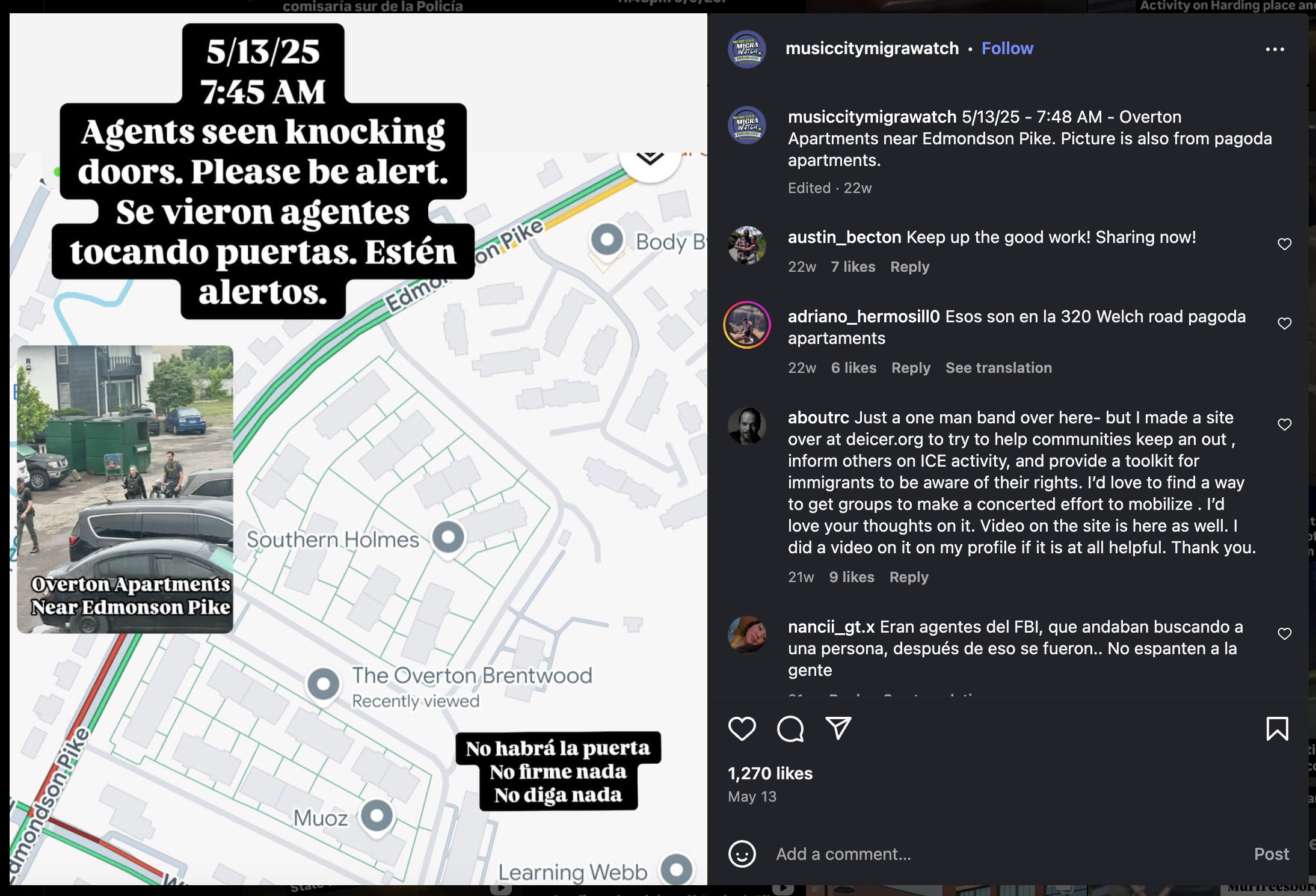
Our investigation found these claims to be largely false. By matching ICE data with police reports and the names provided by the agency in its May 13 press release, we determined that at most 159 people were detained by ICE in the Nashville area, not 196—and that of those 159, only 40 had been convicted of a crime, not 95, as ICE claimed. The most common reason for a past conviction was a DUI, followed by traffic offense and forgery.
And instead of the “worst of the worst,” as Noem claimed, the majority of people arrested were in the process of adjusting their immigration status, or like many of the Venezuelan immigrants caught in the operation, previously had temporary protected status, which provides recipients with a legal work visa. The Trump administration revoked protective status for Venezuelans, despite court challenges, in early 2025.
Mike Holley, an attorney with TIRRC who represented some of the people detained during the operation, said he heard from many who had pending immigration court cases but were arrested anyway. “They were deliberately taking people who were the worst candidates for deportation,” he said. “People with ties to the community who were already in the system and have no criminal record. During ordinary times they would probably have released someone like that.”
“It was incredible to watch a city that’s so vibrant and full of people come to a standstill.”
Holley said it was clear that THP was racially profiling people from the footage he viewed of the first night of the operation. Holley called them “roving immigration patrols” and said they violated the pretextual stop doctrine and the Constitution. “This all goes back to the equal protection clause of the Fifth and 14th Amendments,” he said. “Tennessee has a parallel under the Tennessee Constitution…Even if you can stop someone pretextually for not using a turn signal, it can’t be based on race. You can’t just sit out there and say, ‘I’m gonna stop every Black person that doesn’t use their signal.’ But that’s what they chose to do. And that’s not allowed.” (Following Justice Brett Kavanaugh’s concurrence to a Supreme Court ruling in September, in which the court okayed the use of race by immigration officers as a proxy for immigration status, this brand of profiling became known as a “Kavanaugh stop.”)
In this case, however, it was largely Nashville’s thriving Latino community that was targeted, not its Black residents. Analyzing the ICE deportation data for the weeklong enforcement operation, we found that the overwhelming majority of people arrested were Latin American, with most being from Mexico and Guatemala, followed by Honduras, Venezuela, and El Salvador. At least seven people from the Middle East were also arrested during the dragnet, including people originally from Egypt, Iraq, Jordan, and Saudi Arabia.
Ramirez said it was startling to see the busy streets of Nashville empty out as the enforcement operation continued in immigrant communities. “It was incredible to watch a city that’s so vibrant and full of people come to a standstill,” she said. “There was just this fear in our community, and this hyper-alertness. Every vehicle looked suspicious.”
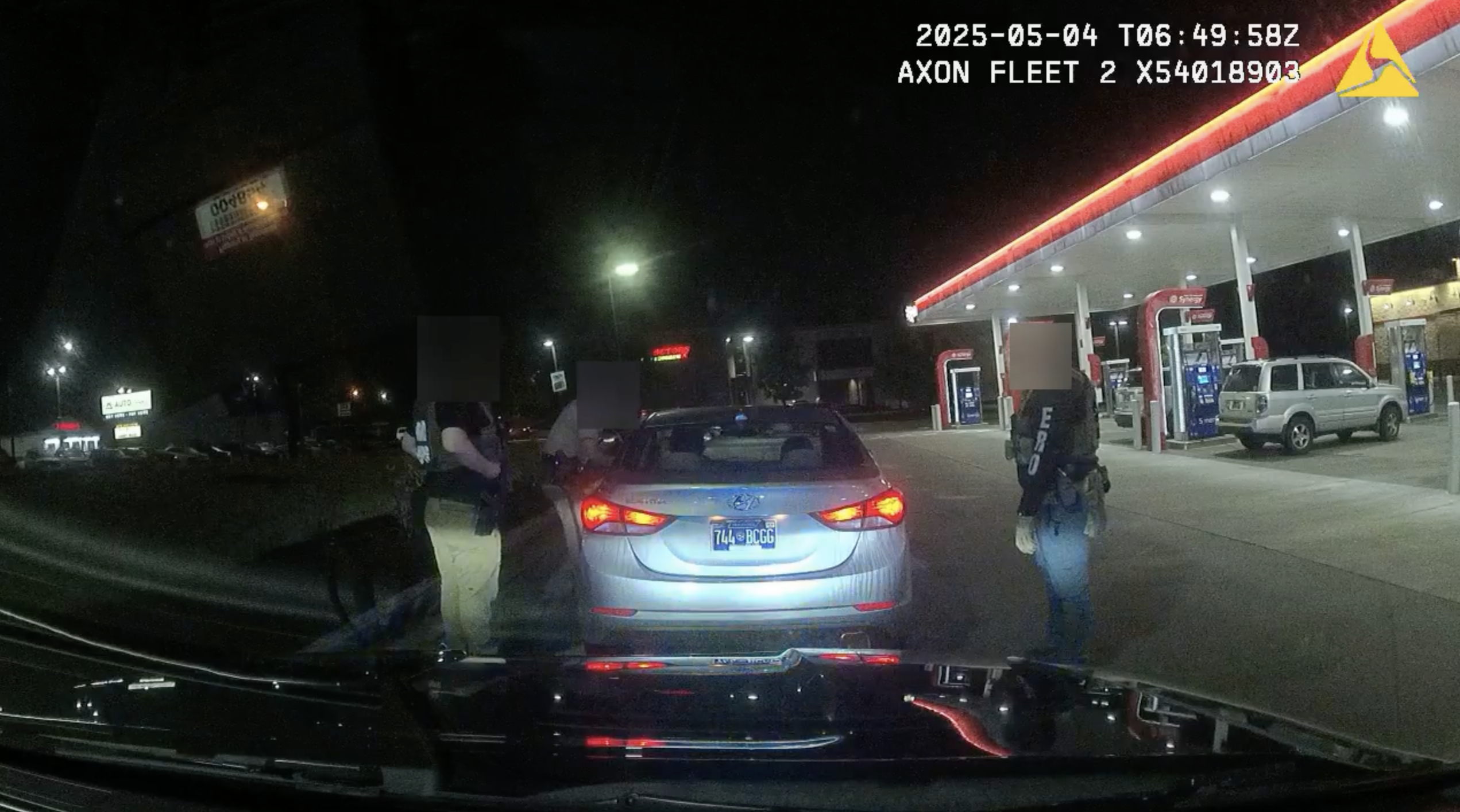
In late October, city council member Terry Vo pointed out the MAPCO gas station in South Nashville where she’d witnessed Campos’ arrest. “It still haunts me,” she said.
That night, Vo had been driving around with Zulfat Suara and other city council members who are members of the Metro Council Immigrant Caucus to understand whom the state troopers and ICE were targeting. Vo pulled into the gas station to discover Campos surrounded by armed agents, with volunteer monitors from Music City MigraWatch yelling at him not to open his door.
“There are probably many more Edgardos out there that nobody knows about, right?”
As we pulled into the gas station, she pointed to a parking space in front of the convenience store. “That’s where they left his car,” she said. “At the time, we didn’t know who he was, who his family was.” Vo said the police and ICE left Campos’ car unlocked, and the council members searched it for contact information. “We didn’t know his name. We didn’t know anything about him. At that point, we handed it over to community advocates, who were eventually able to notify his family.”
Vo shook her head, visibly frustrated. “It was sad,” she said. “He’s an older man in the later years of his life and a very devout person. I often think, ‘Could I have done better?’” she asked. “I think if the community had not been there that night to record and watch, we wouldn’t even know he was taken. And there are probably many more Edgardos out there that nobody knows about, right?”
Holley said lawyers at TIRRC scrambled to reach people in detention, like Campos, during the operation, but they were moved quickly from one jail to the next in Tennessee and then to Louisiana or Texas, with no way to contact legal help and limited communication with family members. “A lot of people agreed to deportation before there was even a chance to talk with them,” Holley said. “They were either gone or had already signed something.”
The question of what happened to Campos and to the dozens of other people detained over those seven days has remained an open one for city officials like Vo, advocates, and members of the community. ICE and other state authorities have refused to say. The operation and its impact have remained a black box.
To provide answers, we analyzed ICE deportation data and Tennessee Highway Patrol incident reports. In Campos’ case, according to the THP, he was marked down as a “stopping violator.” This is the only reason stated in at least 90 percent of the Tennessee Highway Patrol traffic reports we analyzed from the Nashville operation.
After being taken into ICE custody, Campos was sent to the Putnam County Jail, 80 miles east of Nashville. After three days, he was transferred further east to the Knox County Detention Center. Like many people picked up during the operation in Nashville, Campos was transferred within days from Tennessee to Louisiana. Our investigation found that as of mid-October 2025, according to the most current publicly available ICE deportation data, 121 people were deported and 15 people were bonded out after being sent to Louisiana. An additional 12 people still remain in jail.
On May 16, Campos was sent to the Jackson Parish Correctional Center, in Jonesboro, Louisiana, which is run by the private LaSalle Corrections and has been cited for numerous violations of human rights and state detention standards. After nearly a month, he was deported to El Salvador on June 13.
ICE removal data lists Campos as a “threat level 1 convicted criminal for Fraud and Impersonating,” considered the most serious level of conviction. According to police records, Campos was charged in 2008 for a DUI. ICE’s removal charge, however, for fraud and impersonating, is based on a 25-year-old conviction for a fake ID and no driver’s license. (Undocumented immigrants cannot obtain driver’s licenses legally in Tennessee.)
“The pain had become too much,” Campos’ wife told us. “Who deserves this?”
After community advocates located Campos’ wife, Martha, she told them that her husband had been on his way home the night he was detained from mass at Nuestra Señora de Guadalupe Catholic Church in South Nashville. “I’m shattered because one doesn’t expect a blow this devastating,” she said in an interview with Nashville Noticias.
After Campos’ arrest, the Diocese of Nashville advised parishioners in a public bulletin to stay home. Many churchgoers never returned, said Martín Ochoa, a longtime parishioner at Nuestra Señora de Guadalupe. Ochoa said Campos and his wife had donated toys to the church’s annual Christmas collection for years. This year, the donation never came.
In a brief conversation at the church, Martha confirmed that her husband had been deported to El Salvador and said she did not want to speak further about the ordeal. “The pain had become too much,” she said. “Who deserves this?”
“I find it really interesting,” said Vo, “this narrative that was laid out that ‘We’re only going after the criminals,’ which made people feel comfortable that they wouldn’t be targeted—like, ‘Oh, they’re not coming after me. They’re only going after the bad people,’” she said. “But that was a farce. They’d pull you over, then look you up, thinking, ‘Oh, maybe we’ll catch somebody.’”
Five months after the dragnet, families gathered in North Nashville for Shwab Elementary School’s Halloween festival. The sun had finally come out, and parents watched as small children in costumes drew with crayons and others ran happily across the playground.
According to Principal Cheryl Bowman, the school’s student population is 56 percent Latino. Bowman said Shwab was still struggling to convince immigrant families that their children would be safe from ICE agents at school. These days, she said, they were lucky to get 100 people to attend a school function, about half of what they’d been accustomed to in the past. “We’ve done a lot of footwork going to families’ homes,” Bowman said, “and they’re just afraid to send their kids to school.”
“There are a lot of four-year-olds sitting at home.”
In fact, for the first time in her nine years at Shwab, the school’s pre-K program didn’t have a waiting list. The school was doing outreach to try to fill its two pre-K classes. “This is the first time since I’ve been here that we’ve had low enrollment,” Bowman said. “There are a lot of four-year-olds sitting at home.”
Because of the decline in enrollment, Bowman said she had had to let a teacher go and lost $140,000 in federal funding. Things got so bad during the May enforcement operation, she said, that teachers volunteered to drive students to school, because their parents were too afraid to leave their homes. “We just did what we had to do, because they needed to come to school,” she said.
Bowman said many families had left the school, either moving to other parts of Tennessee with less ICE presence or leaving the state altogether. “We’re family here, and it’s just very hurtful,” she said.
As school enrollment plummeted, businesses also suffered. In South Nashville, not far from where Campos was dragged from his car, Ishaq Albdi, whose family owns a string of grocery markets catering to Latinos, said sales had declined by 20 percent. “It has definitely hurt our business,” he said.
Customers asked for deliveries, because they were too afraid to leave their homes, he said. “There were people who would come in regularly. These were long-term customers,” he said. “And now they’re gone, and we don’t know if they were deported.”
This year’s legislation will require teachers, judges, social workers, and others to report undocumented immigrants to ICE and the state’s immigration division.
Several months later, in January, Tennessee Republicans introduced a slate of anti-immigrant bills, written in consultation with the White House’s Miller, that are designed to make the lives of immigrants even more inhospitable—yet another example of the state’s eagerness to lead the way on draconian deportation policies. During the last legislative session, Republican leaders created an immigrant enforcement office and declared that public records from the agency would remain confidential, including programs funded with federal tax dollars. This year’s legislation will require teachers, judges, social workers, and others to report undocumented immigrants to ICE and the state’s immigration division. Schools could also be required to verify immigration status for children attending school and either exclude them or charge tuition if they are undocumented. Another bill would allow state troopers to check the immigration status of out-of-state drivers passing through the state. And state or local officials who share information about ICE officers will face a felony charge and removal from office, an apparent response to Nashville Mayor Freddie O’Connell’s release of public documents naming some of the ICE agents involved in the operation last May.
Jazmin Ramirez, the TIRRC community organizer who has been commuting from Nashville to Memphis to help families there, said immigrants would not be deterred by the state’s draconian laws. “We were preparing for this as a community, but we were hoping it wouldn’t come,” she said. “We’re also not surprised that they’re here. In many ways, Tennessee has been a testing ground for a lot of these things.”
Nashville’s immigrant community is still paying the price. On a sidewalk near the Latino supermarket, a handful of day laborers regularly congregate, hoping for a day or two of wages. One man, who said he had lived in Nashville for 22 years and asked to remain anonymous, said ICE had come and taken people away from there in May. Months later, workers were still coming to the location because they needed to work to survive, he said, but they were afraid. “There are less people here now waiting for work,” said the man in Spanish. “But we are still here, because we have to work. We just hope they don’t come back.”
Araceli Crescencio contributed to this report.
This story was produced as part of a collaboration coordinated by Lighthouse Reports, in partnership with the Institute for Public Service Reporting, the Nashville Banner, Nashville Noticias, and NewsChannel 5 Nashville.